
Treasury Regulations · 26 CFR
§ 1.1274-2. Issue price of debt instruments to which section 1274 applies.
Regulation text, no changes From the eCFR, current as of October 15, 2026. The eCFR is an authoritative but unofficial editorial compilation of the Code of Federal Regulations; the official text is the annual CFR on govinfo. Compare it with this section on ecfr.gov (external site) or the official annual CFR on govinfo (external site).
Regulation under 26 U.S.C. § 1274
Cite as 26 CFR § 1.1274-2
At a glance
Read from the text and its source citation. Not part of the regulation.
- Status
- In the current eCFR
- Issued
- February 2, 1994 by T.D. 8517
- Last amended
- June 14, 1996 by T.D. 8674
- Issued under
- 26 U.S.C. § 1274
- Length
- 2,585 words · about 11 min to read
- Cross-references
- cites 4 Code sections and 7 regulations; cited by 9
(i) Facts. On January 1, 1995, A sells nonpublicly traded property to B for a stated purchase price of $3,500,000. In consideration for the sale, B makes a down payment of $500,000 and issues a 10-year debt instrument with a stated principal amount of $3,000,000, payable at maturity. The debt instrument calls for no interest in the first 2 years and interest at a rate of 15 percent payable annually over the remaining 8 years of the debt instrument. The first interest payment of $450,000 is due on December 31, 1997, and the last interest payment is due on December 31, 2004, together with the $3,000,000 payment of principal. Assume that the test rate of interest applicable to the debt instrument is 10.5 percent, compounded annually.
(ii) Applicability of section 1274. Because the debt instrument does not provide for any interest during the first 2 years, none of the interest on the debt instrument is qualified stated interest. Therefore, the issue price of the debt instrument is determined under section 1274. See § 1.1274-1(b)(1). If the debt instrument has adequate stated interest, the issue price of the instrument is its stated principal amount. Otherwise, the issue price of the debt instrument is its imputed principal amount. The debt instrument has adequate stated interest only if the stated principal amount is less than or equal to the imputed principal amount.
(iii) Determination of imputed principal amount. To compute the imputed principal amount of the debt instrument, all payments due under the debt instrument are discounted back to the issue date at 10.5 percent, compounded annually, as follows:
(A) The present value of the $3,000,000 principal payment payable on December 31, 2004, is $1,105,346.59, determined as follows:
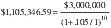
(B) The present value of the eight interest payments of $450,000 as of January 1, 1997, is $2,357,634.55, determined as follows:

(C) The present value of this interim amount as of January 1, 1995, is $1,930,865.09, determined as follows:
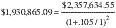
(iv) Determination of issue price. The debt instrument's imputed principal amount (that is, the present value of all payments due under the debt instrument) is $3,036,211.68 ($1,105,346.59 + $1,930,865.09). Because the stated principal amount ($3,000,000) is less than the imputed principal amount, the debt instrument provides for adequate stated interest. Therefore, the issue price of the debt instrument is its stated principal amount ($3,000,000).
(i) Facts. On January 1, 1995, in partial consideration for the sale of nonpublicly traded property, H corporation issues to G a 10-year debt instrument, maturing on January 1, 2005, with a stated principal amount of $10,000,000, payable on that date. The debt instrument provides for annual payments of interest of 8 percent for the first 5 years and 14 percent for the final 5 years, payable on January 1 of each year, beginning on January 1, 1996. In addition the debt instrument provides H with the unconditional option to call (prepay) the debt instrument at the end of 5 years for its stated principal amount of $10,000,000. Assume that the Federal mid-term and long-term rates applicable to the sale based on annual compounding are 9 percent and 10 percent, respectively.
(ii) Option presumed exercised. Assuming exercise of the call option, the imputed principal amount as determined under paragraph (d) of this section is $9,611,034.87 (the present value of all of the payments due within a 5-year term discounted at a test rate of 9 percent, compounded annually). Assuming nonexercise of the call option, the imputed principal amount is $10,183,354.78 (the present value of all of the payments due within a 10-year term discounted at a test rate of 10 percent, compounded annually). For purposes of determining the imputed principal amount, the option is presumed exercised because the imputed principal amount, assuming exercise of the option, is less than the imputed principal amount, assuming the option is not exercised. Because the option is presumed exercised, the debt instrument fails to provide for adequate stated interest because the imputed principal amount ($9,611,034.87) is less than the stated principal amount ($10,000,000). Thus, the issue price of the debt instrument is $9,611,034.87.
(i) Facts. On January 1, 1995, A sells B nonpublicly traded property. In partial consideration for the sale, B issues a debt instrument in the principal amount of $1,000,000, payable in 5 years. The debt instrument calls for interest payable monthly at a rate of 1 percentage point above the average prime lending rate of a major bank for the month preceding the month of the interest payment. Assume that the test rate of interest applicable to the debt instrument is 10.5 percent, compounded monthly. Assume also that 1 percentage point above the prime lending rate of the designated bank on the date of the sale is 12.5 percent, compounded monthly, which is greater than 1 percentage point above the prime lending rate of the designated bank on the first date on which there is a binding written contract that substantially sets forth the terms under which the sale is consummated.
(ii) Debt instrument has adequate stated interest. The debt instrument is a variable rate debt instrument (within the meaning of § 1.1275-5) that provides for stated interest at a qualified floating rate. Under paragraph (f)(1)(i) of this section, the debt instrument is treated as if it provided for a fixed rate of interest equal to 12.5 percent, compounded monthly. Because the test rate of interest is 10.5 percent, compounded monthly, the debt instrument provides for adequate stated interest.
On July 1, 1995, A sells nonpublicly traded property to B in return for a debt instrument with a stated principal amount of $10,000,000, payable on July 1, 2005. Interest is payable on July 1 of each year, beginning on July 1, 1996, at the Federal short-term rate for June of the same year. The debt instrument provides, however, that the interest rate cannot rise above 8.5 percent, compounded annually. Assume that, as of the date the test rate of interest for the debt instrument is determined, the Federal short-term rate is 8 percent, compounded annually. Assume further that, as a result of the interest rate cap of 8.5 percent, compounded annually, the expected yield of the debt instrument is significantly less than the expected yield of the debt instrument if it did not include the interest rate cap. Under paragraph (f)(1)(ii) of this section, the variable payments are treated as contingent payments for purposes of this section.
[T.D. 8517, 59 FR 4821, Feb. 2, 1994, as amended by T.D. 8674, 61 FR 30141, June 14, 1996]
Cross-references
Computed from the citations in the text of 26 CFR.
Code sections it cites
- § 1274 Determination of issue price in the case of certain debt instruments issued for property
- § 1272 Current inclusion in income of original issue discount
- § 1274A Special rules for certain transactions where stated principal amount does not exceed $2,800,000
- § 1275 Other definitions and special rules
Regulations it cites
- § 1.1273-2 Determination of issue price and issue date.
- § 1.1274-3 Potentially abusive situations defined.
- § 1.1274-4 Test rate.
- § 1.1272-1 Current inclusion of OID in income.
- § 1.1275-5 Variable rate debt instruments.
- § 1.1275-4 Contingent payment debt instruments.
- § 1.1274-1 Debt instruments to which section 1274 applies.
Cited by 9 other regulations
- § 1.453-11 Installment obligations received from a liquidating corporation.
- § 1.483-2 Unstated interest.
- § 1.988-6 Nonfunctional currency contingent payment debt instruments.
- § 1.1001-1 Computation of gain or loss.
- § 1.1012-1 Basis of property.
- § 1.1271-0 Original issue discount; effective date; table of contents.
- § 1.1273-2 Determination of issue price and issue date.
- § 1.1275-4 Contingent payment debt instruments.
- § 1.1275-5 Variable rate debt instruments.
Amendment history
From the source citation at the end of the section, newest first. T.D. is a Treasury decision; FR is the Federal Register.
- Amended by T.D. 8674 (61 FR 30141)
- Issued by T.D. 8517 (59 FR 4821)
Where it sits in 26 CFR
- Subchapter A Income tax
- Part 1 Income taxes
- Special Rules for Determining Capital Gains and Losses
Nearby sections
- § 1.1272-3 Election by a holder to treat all interest on a debt instrument as OID.
- § 1.1273-1 Definition of OID.
- § 1.1273-2 Determination of issue price and issue date.
- § 1.1274-1 Debt instruments to which section 1274 applies.
- § 1.1274-2 Issue price of debt instruments to which section 1274 applies.
- § 1.1274-3 Potentially abusive situations defined.
- § 1.1274-4 Test rate.
- § 1.1274-5 Assumptions.
- § 1.1274A-1 Special rules for certain transactions where stated principal amount does not exceed $2,800,000.