
Treasury Regulations · 26 CFR
§ 1.162-28. Allocation of costs to lobbying activities.
Regulation text, no changes From the eCFR, current as of October 15, 2026. The eCFR is an authoritative but unofficial editorial compilation of the Code of Federal Regulations; the official text is the annual CFR on govinfo. Compare it with this section on ecfr.gov (external site) or the official annual CFR on govinfo (external site).
Regulation under 26 U.S.C. § 162
Cite as 26 CFR § 1.162-28
At a glance
Read from the text and its source citation. Not part of the regulation.
- Status
- In the current eCFR
- Issued
- July 21, 1995 by T.D. 8602
- Issued under
- 26 U.S.C. § 162
- Length
- 2,317 words · about 10 min to read
- Cross-references
- cites 6 Code sections and 1 regulation; cited by 1

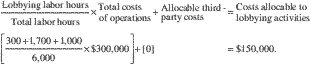
(i) In 1996, three full-time employees, A, B, and C, of Taxpayer W engage in both lobbying activities and nonlobbying activities. A spends 300 hours, B spends 1,700 hours, and C spends 1,000 hours on lobbying activities, for a total of 3,000 hours spent on lobbying activities for W. W reasonably assumes that each of its three employees spends 2,000 hours a year on W's business.
(ii) W's total costs of operations are $300,000. W has no third-party costs.
(iii) Under the ratio method, X allocates $150,000 to its lobbying activities for 1996, as follows:
(i) In 1996, three employees, A, B, and C, of Taxpayer X engage in both lobbying activities and nonlobbying activities. A spends 300 hours, B spends 1,700 hours, and C spends 1,000 hours on lobbying activities.
(ii) X has no third-party costs.
(iii) For purposes of the gross-up method, X determines that its basic labor costs are $20 per hour for A, $30 per hour for B, and $25 per hour for C. Thus, its basic lobbying labor costs are ($20 × 300) + ($30 × 1,700) + ($25 × 1,000), or ($6,000 + $51,000 + $25,000), for total basic lobbying labor costs for 1996 of $82,000.
(iv) Under the gross-up method, X allocates $143,500 to its lobbying activities for 1996, as follows:

(i) Three full-time employees, A, B, and C, work in the Washington office of Taxpayer Y, a manufacturing concern. They each engage in lobbying activities and nonlobbying activities. In 1996, A spends 75 hours, B spends 1,750 hours, and C spends 2,000 hours on lobbying activities. A's hours are not spent on direct contact lobbying as defined in paragraph (g)(2) of this section. All three work 2,000 hours during 1996. The Washington office also employs one secretary, D, who works exclusively for A, B, and C.
(ii) In addition, three departments in the corporate headquarters in Chicago benefit the Washington office: Public affairs, human resources, and insurance.
(iii) Y is subject to section 263A and uses the step-allocation method to allocate its service costs. Prior to the amendments to section 162(e), the Washington office was treated as an overall management function for purposes of section 263A. As such, its costs were fully deductible and no further allocations were made under Y's step allocation. Following the amendments to section 162(e), Y adopts its 263A step-allocation methodology to allocate costs to lobbying activities. Y adds a lobbying department to its step-allocation program, which results in an allocation of costs to the lobbying department from both the Washington office and the Chicago office.
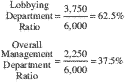
(iv) Y develops a labor ratio to allocate its Washington office costs between the newly defined lobbying department and the overall management department. To determine the hours allocable to lobbying activities, Y uses the de minimis rule of paragraph (g)(1) of this section. Under this rule, A's hours spent on lobbying activities are treated as zero because less than 5 percent of A's time is spent on lobbying (75/2,000 = 3.75%). In addition, because D works exclusively for personnel engaged in lobbying activities, D's hours are not used to develop the allocation ratio. Y assumes that D's allocation of time follows the average time of all the personnel engaged in lobbying activities. Thus, Y's labor ratio is determined as follows:
| Employee | Departments | ||
|---|---|---|---|
| Lobbying hours | Overall management hours | Total hours | |
| A | 0 | 2,000 | 2,000 |
| B | 1,750 | 250 | 2,000 |
| C | 2,000 | 0 | 2,000 |
| Totals | 3,750 | 2,250 | 6,000 |
(v) In 1996, the Washington office has the following costs:
| Account | Amount |
|---|---|
| Professional Salaries and Benefits | $660,000 |
| Clerical Salaries and Benefits | 50,000 |
| Rent Expense | 100,000 |
| Depreciation on Furniture and Equip | 40,000 |
| Utilities | 15,000 |
| Outside Payroll Service | 5,000 |
| Miscellaneous | 10,000 |
| Third-Party Lobbying (Law Firm) | 90,000 |
| Total Washington Costs | $970,000 |
(vi) In addition, $233,800 of costs from the public affairs department, $30,000 of costs from the insurance department, and $5,000 of costs from the human resources department are allocable to the Washington office from departments in Chicago. Therefore, the Washington office costs are allocated to the Lobbying and Overall Management departments as follows:
| Total Washington department costs from above | $970,000 |
| Plus Costs Allocated From Other Departments | 268,800 |
| Less third-party costs directly allocable to lobbying | (90,000) |
| Total Washington office costs | 1,148,800 |
| Lobbying department | Overall management department | |
|---|---|---|
| Department Allocation Ratios | 62.5% | 37.5% |
| × Washington Office Costs | $1,148,800 | $1,148,800 |
| = Costs Allocated to Departments | $718,000 | $430,800 |
(vii) Y's step-allocation for its Lobbying Department is determined as follows:
| Y's step-allocation | Lobbying department |
|---|---|
| Washington costs allocated to lobbying department | $718,000 |
| Plus third-party costs | 90,000 |
| Total costs of lobbying activities | 808,000 |
[T.D. 8602, 60 FR 37573, July 21, 1995]
Cross-references
Computed from the citations in the text of 26 CFR.
Code sections it cites
- § 162 Trade or business expenses
- § 4911 Tax on excess expenditures to influence legislation
- § 6001 Notice or regulations requiring records, statements, and special returns
- § 263A Capitalization and inclusion in inventory costs of certain expenses
- § 6033 Returns by exempt organizations
- § 263 Capital expenditures
Regulations it cites
Cited by 1 other regulation
Amendment history
From the source citation at the end of the section, newest first. T.D. is a Treasury decision; FR is the Federal Register.
- Issued by T.D. 8602 (60 FR 37573)
Where it sits in 26 CFR
- Subchapter A Income tax
- Part 1 Income taxes
- Itemized Deductions for Individuals and Corporations
Nearby sections
- § 1.162-24 Travel expenses of state legislators.
- § 1.162-25 Deductions with respect to noncash fringe benefits.
- § 1.162-25T Deductions with respect to noncash fringe benefits (temporary).
- § 1.162-27 Certain employee remuneration in excess of $1,000,000 not deductible for taxable years beginning on or after January 1, 1994, and for taxable years beginning prior to January 1, 2018.
- § 1.162-28 Allocation of costs to lobbying activities.
- § 1.162-29 Influencing legislation.
- § 1.162-31 The $500,000 deduction limitation for remuneration provided by certain health insurance providers.
- § 1.162-32 Expenses paid or incurred for lodging when not traveling away from home.
- § 1.162-33 Certain employee remuneration in excess of $1,000,000 not deductible for taxable years beginning after December 31, 2017.