
Treasury Regulations · 26 CFR
§ 1.401(a)(4)-7. Imputation of permitted disparity.
Regulation text, no changes From the eCFR, current as of October 15, 2026. The eCFR is an authoritative but unofficial editorial compilation of the Code of Federal Regulations; the official text is the annual CFR on govinfo. Compare it with this section on ecfr.gov (external site) or the official annual CFR on govinfo (external site).
Regulation under 26 U.S.C. § 401(a)(4)
Cite as 26 CFR § 1.401(a)(4)-7
At a glance
Read from the text and its source citation. Not part of the regulation.
- Status
- In the current eCFR
- Issued
- September 3, 1993 by T.D. 8485
- Issued under
- 26 U.S.C. § 401(a)(4)
- Length
- 2,564 words · about 11 min to read
- Cross-references
- cites 4 Code sections and 8 regulations; cited by 13
A Rate = 2 × unadjusted allocation rate
B Rate = unadjusted allocation rate + permitted disparity rate
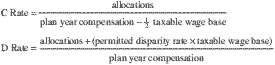
(a) Employees M and N participate in a defined contribution plan maintained by Employer X. Employee M has plan year compensation of $30,000 in the 1990 plan year and has an unadjusted allocation rate of five percent. Employee N has plan year compensation of $100,000 in the 1990 plan year and has an unadjusted allocation rate of eight percent. The taxable wage base in 1990 is $51,300.
(b) Because Employee M's plan year compensation does not exceed the taxable wage base, Employee M's A rate is 10 percent (2 × 5 percent), and Employee M's B rate is 10.7 percent (5 percent + 5.7 percent). Thus, Employee M's adjusted allocation rate is 10 percent, the lesser of the A rate and the B rate.
(c) Employee N's allocations are $8,000 (8 percent × $100,000). Because Employee N's plan year compensation exceeds the taxable wage base, Employee N's C rate is 10.76 percent ($8,000 divided by ($100,000−( 1/2 × $51,300))), and Employee N's D rate is 10.92 percent (($8,000 + (5.7 percent × $51,300)) divided by $100,000). Thus, Employee N's adjusted allocation rate is 10.76 percent, the lesser of the C rate and the D rate.


(a) Employees M and N participate in a defined benefit plan that uses a normal retirement age of 65. The plan is being tested for the plan year under § 1.401(a)(4)-3(c), using unadjusted accrual rates determined using a plan year measurement period under § 1.401(a)(4)-3(d)(1)(iii)(A). Employee M has an unadjusted normal accrual rate of 1.48 percent, average annual compensation of $21,000, and an employer-provided accrual of $311 (1.48 percent × $21,000). Employee N has an unadjusted normal accrual rate of 1.7 percent, average annual compensation of $106,000, and an employer-provided accrual of $1,802 (1.7 percent × $106,000). The covered compensation of both Employees M and N is $25,000, and social security retirement age for both employees is 65. Neither employee has testing service of more than 35 years and neither has ever participated in another plan.
(b) Because Employee M's average annual compensation does not exceed covered compensation, Employee M's A rate is 2.96 percent (2.0 × 1.48 percent), and Employee M's B rate is 2.23 percent (1.48 percent + 0.75 percent). Thus, Employee M's adjusted accrual rate is 2.23 percent, the lesser of the A rate and the B rate.
(c) Because Employee N's average annual compensation exceeds covered compensation, Employee N's C rate is 1.93 percent ($1,802/($106,000−(0.5 × $25,000))), and Employee N's D rate is 1.88 percent (($1,802 + (0.75 percent × $25,000))/$106,000). Thus, Employee N's adjusted accrual rate is 1.88 percent, the lesser of the C rate and the D rate.
[T.D. 8485, 58 FR 46804, Sept. 3, 1993]
Cross-references
Computed from the citations in the text of 26 CFR.
Code sections it cites
- § 401 Qualified pension, profit-sharing, and stock bonus plans
- § 415 Limitations on benefits and contribution under qualified plans
- § 3111 Rate of tax
- § 3221 Rate of tax
Regulations it cites
- § 1.401(a)(4)-2 Nondiscrimination in amount of employer contributions under a defined contribution plan.
- § 1.401(l)-2 Permitted disparity for defined contribution plans.
- § 1.410(b)-5 Average benefit percentage test.
- § 1.401(l)-5 Overall permitted disparity limits.
- § 1.401(a)(4)-13 Effective dates and fresh-start rules.
- § 1.401(l)-1 Permitted disparity in employer-provided contributions or benefits.
- § 1.401(a)(4)-3 Nondiscrimination in amount of employer-provided benefits under a defined benefit plan.
- § 1.401(l)-3 Permitted disparity for defined benefit plans.
Cited by 13 other regulations
- § 1.401(a)(4)-0 Table of contents.
- § 1.401(a)(4)-2 Nondiscrimination in amount of employer contributions under a defined contribution plan.
- § 1.401(a)(4)-3 Nondiscrimination in amount of employer-provided benefits under a defined benefit plan.
- § 1.401(a)(4)-8 Cross-testing.
- § 1.401(a)(4)-9 Plan aggregation and restructuring.
- § 1.401(a)(4)-10 Testing of former employees.
- § 1.401(a)(4)-12 Definitions.
- § 1.401(a)(4)-13 Effective dates and fresh-start rules.
- § 1.401(k)-3 Safe harbor requirements.
- § 1.401(l)-1 Permitted disparity in employer-provided contributions or benefits.
- § 1.401(l)-5 Overall permitted disparity limits.
- § 1.410(b)-5 Average benefit percentage test.
- § 1.414(r)-5 Qualified separate line of business—administrative scrutiny requirement—safe harbors.
Amendment history
From the source citation at the end of the section, newest first. T.D. is a Treasury decision; FR is the Federal Register.
- Issued by T.D. 8485 (58 FR 46804)
Where it sits in 26 CFR
- Subchapter A Income tax
- Part 1 Income taxes
- Pension, Profit-Sharing, Stock Bonus Plans, etc.
Nearby sections
- § 1.401(a)(4)-3 Nondiscrimination in amount of employer-provided benefits under a defined benefit plan.
- § 1.401(a)(4)-4 Nondiscriminatory availability of benefits, rights, and features.
- § 1.401(a)(4)-5 Plan amendments and plan terminations.
- § 1.401(a)(4)-6 Contributory defined benefit plans.
- § 1.401(a)(4)-7 Imputation of permitted disparity.
- § 1.401(a)(4)-8 Cross-testing.
- § 1.401(a)(4)-9 Plan aggregation and restructuring.
- § 1.401(a)(4)-10 Testing of former employees.
- § 1.401(a)(4)-11 Additional rules.