
Treasury Regulations · 26 CFR
§ 1.448-3. Nonaccrual of certain amounts by service providers.
Regulation text, no changes From the eCFR, current as of October 15, 2026. The eCFR is an authoritative but unofficial editorial compilation of the Code of Federal Regulations; the official text is the annual CFR on govinfo. Compare it with this section on ecfr.gov (external site) or the official annual CFR on govinfo (external site).
Regulation under 26 U.S.C. § 448
Cite as 26 CFR § 1.448-3
At a glance
Read from the text and its source citation. Not part of the regulation.
- Status
- In the current eCFR
- Issued
- September 6, 2006 by T.D. 9285
- Last amended
- January 5, 2021 by T.D. 9942
- Issued under
- 26 U.S.C. § 448
- Length
- 7,958 words · about 35 min to read
- Defines
- 2 terms
- Cross-references
- cites 4 Code sections and 5 regulations; cited by 0




B, a healthcare provider, performs a medical procedure on individual C, who has health insurance coverage with IC, an insurance company. B bills IC and C for $5,000, B's standard charge for this medical procedure. However, B has a contract with IC that obligates B to accept $3,500 as full payment for the medical procedure if the procedure is provided to a patient insured by IC. Under the contract, only $3,500 of the $5,000 billed by B is legally collectible from IC and C. The remaining $1,500 represents a contractual allowance or contractual adjustment. Under paragraph (c)(1)(i) of this section, the remaining $1,500 is not a contractually collectible amount for purposes of this section and B may not use a nonaccrual-experience method with respect to this portion of the receivable.
D, a law firm, agrees to represent individual E in a legal matter and to provide services to E on a pro bono basis. D normally charges $500 for these services. Because D provides its services to E pro bono, D's services are never billed or intended to result in revenue. Thus, under paragraph (c)(1)(i) of this section, the $500 is not a collectible amount for purposes of this section and D may not use a nonaccrual-experience method with respect to this portion of the receivable.
Z has two billing methods for the amounts to be received from Z's provision of services described in paragraph (a)(1) of this section. Under one method, for amounts that are more than 90 days past due, Z charges interest at a market rate until the amounts (together with interest) are paid. Under the other billing method, Z charges no interest for amounts past due. Under paragraph (c)(1)(ii) of this section, A may not use a nonaccrual-experience method of accounting with respect to any of the amounts billed under the method that charges interest on amounts that are more than 90 days past due. Z may, however, use the nonaccrual-experience method with respect to the amounts billed under the method that does not charge interest for amounts past due.
(i) F uses the revenue-based moving average method described in paragraph (f)(1) of this section with an applicable period of six taxable years. F's total accounts receivable and bad debt experience for the 2006 taxable year and the five immediately preceding consecutive taxable years are as follows:
| Taxable year | Total accounts receivable earned during the taxable year | Bad debts adjusted for recoveries |
|---|---|---|
| 2001 | $40,000 | $5,700 |
| 2002 | 40,000 | 7,200 |
| 2003 | 40,000 | 11,000 |
| 2004 | 60,000 | 10,200 |
| 2005 | 70,000 | 14,000 |
| 2006 | 80,000 | 16,800 |
| Total | 330,000 | 64,900 |
(ii) F's revenue-based moving average percentage is 19.67% ($64,900/$330,000). If $49,300 of accounts receivable remains outstanding as of the close of that taxable year (2006), F's uncollectible amount using the revenue-based moving average safe harbor method is computed by multiplying $49,300 by the revenue-based moving average percentage of 19.67%, or $9,697. Thus, F may exclude $9,697 from gross income for 2006.
(i) G is eligible to use a nonaccrual-experience method and wishes to adopt the actual experience method of paragraph (f)(2) of this section. G elects to use a three-year applicable period consisting of the current and two immediately preceding consecutive taxable years. G determines that its actual accounts receivable collection experience is as follows:
| Taxable year | Total A/R balance at beginning of taxable year | Bad debts, adjusted for recoveries, related to A/R balance at beginning of taxable year |
|---|---|---|
| 2006 | $1,000,000 | $35,000 |
| 2007 | 760,000 | 75,000 |
| 2008 | 1,975,000 | 65,000 |
| Total | 3,735,000 | 175,000 |
(ii) G's ending A/R Balance on December 31, 2008, is $880,000. In 2008, G computes its uncollectible amount by using a three-year moving average under paragraph (f)(2) of this section. G's moving average nonaccrual-experience percentage is 4.7%, determined by dividing the sum of the amount of G's accounts receivable outstanding on January 1 of 2006, 2007, and 2008, that were determined to be bad debts (adjusted for recoveries allocable to the bad debts) on or before the corresponding determination date(s), by the sum of the amount of G's accounts receivable outstanding on January 1 of 2006, 2007, and 2008 ($175,000/$3,735,000 or 4.7%). G's uncollectible amount for 2008 is determined by multiplying this percentage by the balance of G's accounts receivable on December 31, 2008 ($880,000 × 4.7% = $41,360), and increasing this amount by 105% ($41,360 × 105% = $43,428). G may exclude $43,428 from gross income for 2008.
H is eligible to use a nonaccrual-experience method and wishes to adopt the actual experience method of paragraph (f)(2) of this section. H elects to use a six-year applicable period consisting of the current and five immediately preceding taxable years. H also elects to use a single determination date in accordance with paragraph (f)(2)(i) of this section. H selects December 31, its taxable year-end, as its determination date. Since H is using a single determination date from the current taxable year, its determination date for the 2001-2006 applicable period is December 31, 2006. H has a $800 charge-off in 2003 of an account receivable in the 2003 beginning accounts receivable balance. In 2005, H has a recovery of $100 which is traceable, without undue burden, to the $800 charge-off in 2003. Since the $100 recovery occurred prior to H's December 31, 2006, determination date, it reduces the amount of H's bad debts in the numerator of the formula for purposes of determining H's moving average nonaccrual-experience percentage. In addition, H must include the $100 recovery in income in 2005 (see paragraph (d)(5) of this section regarding recoveries).
The facts are the same as in Example 6, except H elects to use multiple determination dates in accordance with paragraph (f)(2)(ii) of this section. Consequently, H's determination date is December 31, 2001, for its calculations of the portion of the numerator relating to the 2001 taxable year, December 31, 2002, for its calculations of the portion of the numerator relating to the 2002 taxable year, and so on through the final taxable year (2006), which has a determination date of December 31, 2006. Since the $100 recovery did not occur until after December 31, 2003 (the determination date for the 2003 taxable year), it does not reduce the amount of H's bad debts in the numerator of the formula for purposes of determining H's moving average nonaccrual-experience percentage. However, H still must include the $100 recovery in income in 2005 (see paragraph (d)(5) of this section regarding recoveries).
(i) J uses the modified Black Motor method described in paragraph (f)(3) of this section and a six-year applicable period. J's total accounts receivable and bad debt experience for the 2006 taxable year and the five immediately preceding consecutive taxable years are as follows:
| Taxable year | Accounts receivable at end of taxable year | Bad debts (adjusted for recoveries) |
|---|---|---|
| 2001 | $130,000 | $9,100 |
| 2002 | 140,000 | 7,000 |
| 2003 | 140,000 | 14,000 |
| 2004 | 160,000 | 14,400 |
| 2005 | 170,000 | 20,400 |
| 2006 | 180,000 | 10,800 |
| Total | 920,000 | 75,700 |
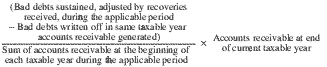
(ii) J's modified Black Motor moving average percentage is 8.228% ($75,700/$920,000). If the accounts receivable generated and written off during the current taxable year are $3,600, J's uncollectible amount is $11,210, computed by multiplying J's accounts receivable on December 31, 2006 ($180,000) by the modified Black Motor moving average percentage of 8.228% and reducing the resulting amount by $3,600 (J's accounts receivable generated and written off during the 2006 taxable year). J may exclude $11,210 from gross income for 2006.
(i) The facts are the same as in Example 8, except that the balances represent accounts receivable at the beginning of the taxable year, and J uses the modified moving average method described in paragraph (f)(4) of this section and a six-year applicable period. Furthermore, the accounts receivable that were written off in the same taxable year they were generated, adjusted for recoveries of bad debts during the period are as follows:
| Taxable year | Accounts receivable written off in same taxable year as generated (adjusted for recoveries) |
|---|---|
| 2001 | $3,033 |
| 2002 | 2,333 |
| 2003 | 4,667 |
| 2004 | 4,800 |
| 2005 | 6,800 |
| 2006 | 3,600 |
| Total | 25,233 |
(ii) J's modified moving average percentage is 5.486% (($75,700−$25,233)/$920,000). J's uncollectible amount is $9,875, computed by multiplying J's accounts receivable on December 31, 2006 ($180,000) by the modified moving average percentage of 5.486%. J may exclude $9,875 from gross income for 2006.
Beginning in 2006, K is eligible to use a nonaccrual-experience method and wants to adopt an alternative nonaccrual-experience method under paragraph (f)(5) of this section, and consequently is subject to the safe harbor comparison method of self-testing under paragraph (e)(3) of this section. K elects to self-test against safe harbor 1 for purposes of conducting its first-year self-test. K's uncollectible amount for 2006 is $22,000. K's safe harbor uncollectible amount under safe harbor 1 is $21,000. Because K's uncollectible amount for 2006 ($22,000) is greater than the safe harbor uncollectible amount ($21,000), K's alternative nonaccrual-experience method is treated as not clearly reflecting its nonaccrual experience for 2006. Accordingly, K must adopt either another nonaccrual-experience method that clearly reflects experience (subject to the self-testing requirements of paragraph (e)(2)(ii) of this section, or a safe harbor nonaccrual-experience method described in paragraph (f)(1) (revenue-based moving average), (f)(2) (actual experience method), (f)(3) (modified Black Motor method), (f)(4) (modified moving average method) of this section, or another alternative nonaccrual-experience method under paragraph (f)(5) of this section that meets the self-testing requirements of paragraph (e)(3) of this section.
The facts are the same as in Example 10, except that K's safe harbor uncollectible amount under safe harbor 1 for 2006 is also $22,000. Consequently, K meets the first-year self-test requirement and may use its alternative nonaccrual-experience method. Subsequently, K's cumulative uncollectible amount for 2007 through 2009 is $300,000. K's safe harbor uncollectible amount for 2007 through 2009 under its chosen safe harbor method for self-testing (safe harbor 1) is $295,000. Because K's cumulative uncollectible amount for the three-year test period (taxable years 2007 through 2009) is greater than its safe harbor uncollectible amount for the three-year test period ($295,000), under paragraph (e)(3)(ii)(B) of this section, the $5,000 excess of K's cumulative uncollectible amount over K's safe harbor uncollectible amount for the three-year test period must be recaptured into income in 2009 in accordance with paragraph (e)(3)(ii)(B) of this section. Since K's cumulative uncollectible amount for the three-year test period ($300,000) is less than 110% of its safe harbor uncollectible amount ($295,000 × 110% = $324,500), under paragraph (e)(3)(ii)(B) of this section, K may continue to use its alternative nonaccrual-experience method, subject to the three-year self-test requirement.
The facts are the same as in Example 4, except that one of the accounts receivable outstanding at the end of 2002 was for $8,000, and in 2003, under section 166, the entire amount of this receivable becomes wholly worthless. Because F does not accrue as income $1,573 of this account receivable ($8,000 × .1967) under the nonaccrual-experience method in 2002, under paragraph (d)(2) of this section F may not deduct this portion of the account receivable as a bad debt deduction under section 166 in 2003. F may deduct the remaining balance of the receivable in 2003 as a bad debt deduction under section 166 ($8,000−$1,574 = $6,426).
The facts are the same as in Example 4. In 2007, F collects in full an account receivable of $1,700 that was outstanding at the end of 2006. Under paragraph (d)(5) of this section, F must recognize additional gross income in 2007 equal to the portion of this receivable that F excluded from gross income in the prior taxable year ($1,700 × .1967 = $334). That amount ($334) is a recovery under paragraph (d)(5) of this section.
[T.D. 9285, 71 FR 52437, Sept. 6, 2006. Redesignated and amended at T.D. 9942, 86 FR 272, Jan. 5, 2021]
Terms defined here
Where the text says “the term … means”. Select a term to jump to its definition.
Cross-references
Computed from the citations in the text of 26 CFR.
Code sections it cites
- § 448 Limitation on use of cash method of accounting
- § 7701 Definitions
- § 446 General rule for methods of accounting
- § 166 Bad debts
Regulations it cites
- § 1.448-1T Limitation on the use of the cash receipts and disbursements method of accounting (temporary).
- § 1.448-2 Limitation on the use of the cash receipts and disbursements method of accounting for taxable years beginning after December 31, 2017.
- § 1.446-1 General rule for methods of accounting.
- § 1.52-2 Adjustments for acquisitions and dispositions.
- § 1.6001-1 Records.
Amendment history
From the source citation at the end of the section, newest first. T.D. is a Treasury decision; FR is the Federal Register.
- Amended by T.D. 9942 (86 FR 272)
- Issued by T.D. 9285 (71 FR 52437)
Where it sits in 26 CFR
- Subchapter A Income tax
- Part 1 Income taxes
- Methods of accounting in general
Nearby sections
- § 1.446-7 Net asset value method for certain money market fund shares.
- § 1.448-1 Limitation on the use of the cash receipts and disbursements method of accounting.
- § 1.448-1T Limitation on the use of the cash receipts and disbursements method of accounting (temporary).
- § 1.448-2 Limitation on the use of the cash receipts and disbursements method of accounting for taxable years beginning after December 31, 2017.
- § 1.448-3 Nonaccrual of certain amounts by service providers.