
Treasury Regulations · 26 CFR
§ 1.453-3. Purchaser evidences of indebtedness payable on demand or readily tradable.
Regulation text, no changes From the eCFR, current as of October 15, 2026. The eCFR is an authoritative but unofficial editorial compilation of the Code of Federal Regulations; the official text is the annual CFR on govinfo. Compare it with this section on ecfr.gov (external site) or the official annual CFR on govinfo (external site).
Regulation under 26 U.S.C. § 453
Cite as 26 CFR § 1.453-3
At a glance
Read from the text and its source citation. Not part of the regulation.
- Status
- In the current eCFR
- Issued
- July 11, 1972 by T.D. 7197
- Issued under
- 26 U.S.C. § 453
- Length
- 2,142 words · about 9 min to read
- Defines
- 1 term
- Cross-references
- cites 1 Code section and 0 regulations; cited by 2
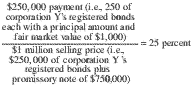
On July 1, 1970, A, an individual on the cash method of accounting reporting on a calendar year basis, transferred all of his stock in corporation X (traded on an established securities market and having a fair market value of $1 million) to corporation Y in exchange for 250 of corporation Y's registered bonds (which are traded in an over-the-counter bond market) each with a principal amount and fair market value of $1,000 (with interest payable at the rate of 8 percent per year), and Y's unsecured promissory note, with a principal amount of $750,000. At the time of such exchange A's basis in the corporation X stock is $900,000. The promissory note is payable at the rate of $75,000 annually, due on July 1, of each year following 1970, until the principal balance is paid. The note provides for the payment of interest at the rate of 10 percent per year also payable on July 1 of each year. Under the rule stated in subparagraph (1) of this paragraph, the 250 registered bonds of corporation Y are treated as a payment for purposes of the 30 percent test described in section 453(b)(2)(A)(ii). The payment on account of the bonds equals 25 percent of the selling price determined as follows:
Since the payments received in the taxable year of the sale do not exceed 30 percent of the selling price and the sales price exceeds $1,000, A may report the income received on the sale of his corporation X stock on the installment method. A elects to report the income on the installment method. The gross profit to be realized when the corporation X stock is fully paid for is 10 percent of the total contract price, computed as follows: $100,000 gross profit (i.e., $1 million contract price less $900,000 basis in corporation X stock) over $1 million contract price. However, since subparagraph (2) of this paragraph also treats the 250 corporation Y registered bonds as a payment for purposes of reporting income, A must include $25,000 (i.e., 10 percent times $250,000) in his gross income for calendar year 1970, the taxable year of sale.
Assume the same facts as in Example 1. Assume further that on July 1, 1971, corporation Y makes its first installment payment to A under the terms of the unsecured promissory note with 75 more of its $1,000 registered bonds. A must include $7,500 (i.e., 10 percent gross profit percentage times $75,000) in his gross income for calendar year 1971. In addition, A includes the interest payment made by corporation Y on July 1, in his gross income for 1971.
For purposes of subdivision (ii) of this subparagraph, the determination as to whether there exist obligations of a comparable character depends upon the particular facts and circumstances. Factors to be considered in making such determination include, but are not limited to, substantial similarity with respect to the presence and nature of security for the obligation, the number of obligations issued (or to be issued), the number of holders of such obligation, the principal amount of the obligation, and other relevant factors.
On June 1, 1971, 25 individuals owning equal interests in a tract of land with a fair market value of $1 million sell the land to corporation Y. The $1 million sales price is represented by 25 bonds issued by corporation Y each having a face value of $40,000. The bonds are not in registered form and do not have interest coupons attached, and, in addition, are payable in 120 equal installments each due on the first business day of each month. In addition, the bonds are negotiable and may be assigned by the holder to any other person. However, the bonds are not quoted by any brokers or dealers who deal in corporate bonds, and, furthermore, there are no comparable obligations of corporation Y (determined with reference to the characteristics set forth in subparagraph (2) of this paragraph) which are so quoted. Therefore, the bonds are not treated as readily tradable in an established securities market. In addition, under the particular facts and circumstances stated, the bonds will not be considered to be in a form designed to render them readily tradeable in an established securities market. Since the bonds are not in registered form, do not have coupons attached, are not in a form designed to render them readily tradable in an established securities market, the receipt of such bonds by the holder is not treated as a payment for purposes of section 453(b), notwithstanding that they are freely assignable.
On April 1, 1972, corporation M purchases in a casual sale of personal property a fleet of trucks from corporation N in exchange for corporation M's negotiable notes, not in registered form and without coupons attached. The corporation M notes are comparable to earlier notes issued by corporation M, which notes are quoted in the Eastern Bond section of the National daily quotation sheet, which is an interdealer quotation system. Both issues of notes are unsecured, held by more than 100 holders, have a maturity date of more than 5 years, and were issued for a comparable principal amount. On the basis of these similar characteristics it appears that the latest notes will also be readily tradable. Since an interdealer system reflects an over-the-counter market, the earlier notes are treated as readily tradable in an established securities market. Since the later notes are obligations comparable to the earlier ones, which are treated as readily tradable in an established securities market, the later notes are also treated as readily tradable in an established securities market (whether or not such notes are actually traded).
[T.D. 7197, 37 FR 13532, July 11, 1972]
Terms defined here
Where the text says “the term … means”. Select a term to jump to its definition.
Cross-references
Computed from the citations in the text of 26 CFR.
Code sections it cites
Cited by 2 other regulations
Amendment history
From the source citation at the end of the section, newest first. T.D. is a Treasury decision; FR is the Federal Register.
- Issued by T.D. 7197 (37 FR 13532)
Where it sits in 26 CFR
- Subchapter A Income tax
- Part 1 Income taxes
- Taxable year for which items of gross income included
Nearby sections
- § 1.451-4 Accounting for redemption of trading stamps and coupons.
- § 1.451-6 Election to include crop insurance proceeds in gross income in the taxable year following the taxable year of destruction or damage.
- § 1.451-7 Election relating to livestock sold on account of drought.
- § 1.451-8 Advance payments for goods, services, and certain other items.
- § 1.453-3 Purchaser evidences of indebtedness payable on demand or readily tradable.
- § 1.453-9 Gain or loss on disposition of installment obligations.
- § 1.453-11 Installment obligations received from a liquidating corporation.
- § 1.453-12 Allocation of unrecaptured section 1250 gain reported on the installment method.
- § 1.453A-0 Table of contents.