
Treasury Regulations · 26 CFR
§ 1.52-1. Trades or businesses that are under common control.
Regulation text, no changes From the eCFR, current as of October 15, 2026. The eCFR is an authoritative but unofficial editorial compilation of the Code of Federal Regulations; the official text is the annual CFR on govinfo. Compare it with this section on ecfr.gov (external site) or the official annual CFR on govinfo (external site).
Regulation under 26 U.S.C. § 52
Cite as 26 CFR § 1.52-1
At a glance
Read from the text and its source citation. Not part of the regulation.
- Status
- In the current eCFR
- Issued
- July 21, 1978 by T.D. 7553
- Last amended
- December 30, 2024 by T.D. 10018
- Issued under
- 26 U.S.C. § 52
- Length
- 3,107 words · about 14 min to read
- Defines
- 9 terms
- Cross-references
- cites 7 Code sections and 6 regulations; cited by 14
(a) Corporation M and its three subsidiaries, Corporations N, O, and P, are a group of businesses that are under common control and each uses the cash receipts and disbursements method of accounting and has a calendar year taxable year. Corporations M, N, O, and P paid out the following amounts in unemployment insurance wages, qualified first-year wages and qualified second-year wages during 1980.
| Unemployment insurance wages | Qualified 1st-Year wages | Qualified 2d-year wages | |
|---|---|---|---|
| Corporation: | |||
| M | $600,000 | $184,000 | $75,000 |
| N | 300,000 | 85,000 | 90,000 |
| O | 360,000 | 120,000 | 115,000 |
| P | 24,000 | 24,000 | 0 |
| Total | 1,284,000 | 413,000 | 280,000 |
(b) Since Corporations M, N, O, and P are under common control, the amount of qualified first-year wages paid by the group is limited to 30 percent of the aggregate unemployment insurance wages paid by the group in the calendar year ending in the group's taxable year. Since the qualified first-year wages of $413,000 exceeds 30% of the aggregate unemployment insurance wages, the group is limited to qualified first-year wages of $385,200 (30% of $1,284,000). The amount of the targeted jobs credit attributable to qualified first-year wages is equal to $192,600 (50% of $385,200). The amount of the credit attributable to qualified second-year wages is equal to $70,000 (25% of $280,000).
(c) The credit is apportioned among Corporations M, N, O, and P on the basis of their proportionate share of the qualified first-year wages or qualified second-year wages giving rise to the credit. Each corporation's share of the credit attributable to qualified first-year wages would be computed as follows:
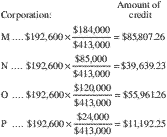
Each corporation's share of the credit attributable to qualified second-year wages is computed as follows:
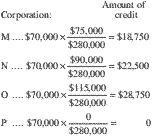
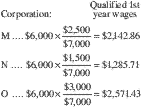
Assume the facts in example 1 with these additional facts. A, a member of a targeted group, worked for more than one of the members of the controlled group in the taxable year. A first began work for Corporation M on January 1, 1980, and later worked for Corporations N and O during 1980. For services rendered by A during 1980, the following wages were paid to A: Corporation M paid A $2,500 of qualified first-year wages: Corporation N paid A $1,500 of qualified first-year wages; Corporation O paid A $3,000 of qualified first-year wages. Corporations M, N, and O paid A a total of $7,000 of wages during 1980. Only $6,000 of qualified first-year wages per year per employee may be taken into account for purposes of the credit. See § 1.51-1(d)(1). Since Corporations M, N, and O are treated as a single employer under section 52(a), the maximum $6,000 of qualified first-year wages paid A by the group must be apportioned among Corporations M, N, and O as follows:
(a) Corporation Q and its two subsidiaries, Corporations R and S, are a group of businesses that are under common control and each uses the cash receipts and disbursements method of accounting. Corporation Q has a calendar year taxable year. Corporation R has a July 1 through June 30 taxable year. Corporation S has an October 1 through September 30 taxable year. For purposes of determining Corporation R's proportionate share of the credit, the credit is computed as if Corporations Q and S have the same taxable year as Corporation R. Accordingly, Corporation R would compute its share of the credit for its 1979-1980 taxable year as set forth below.
| Unemployment insurance wages, 1979 | Qualified wages paid from July 1, 1979, to June 30, 1980 | ||
|---|---|---|---|
| 1st year wages | 2d year wages | ||
| Corporation: | |||
| Q | $500,000 | $150,000 | $80,000 |
| R | 300,000 | 110,000 | 50,000 |
| S | 100,000 | 25,000 | 10,000 |
| Total | 900,000 | 285,000 | 140,000 |
(b) Since Corporations Q, R, and S are under common control, the amount of qualified first-year wages is limited to 30 percent of the aggregate unemployment insurance wages paid by the group during the calendar year ending in Corporation R's taxable year. Since the qualified first-year wages of $285,000 exceeds 30 percent of the aggregate unemployment insurance wages, the group is limited to qualified first-year wages of $270,000 (30% of $900,000). The amount of the targeted jobs credit attributable to qualified first-year wages paid by members of the group during the period of the taxpayer's taxable year is $135,000 (50% of $270,000). The amount of the credit attributable to qualified second-year wages paid or incurred by members of the group during the period of the taxpayer's taxable year is $35,000 (25% of $140,000).
(c) The credit is apportioned to Corporation R on the basis of its proportionate share of the qualified first-year wages and qualified second-year wages giving rise to the credit. Corporation R's share of the credit attributable to qualified first-year wages is $52,105.26

Corporation R's share of the credit attributable to qualified second-year wages is $12,500

Corporation R's share of the credit for its 1979-1980 taxable year is $64,605.26 ($52,105.26 + $12,500).
(a) Corporation T and its three subsidiaries, U, V, and W, are a group of businesses that are under common control and each has a calendar year taxable year. Corporations T, U, V, and W have paid out the following amounts in unemployment insurance wages during 1976 and 1977:
| 1976 | 1977 | Increase in FUTA wages in 1977 over 1976 | |
|---|---|---|---|
| Corporation. | |||
| T | $1,000,000 | $1,015,000 | + $15,000 |
| U | 500,000 | 650,000 | + 150,000 |
| V | 600,000 | 580,000 | −20,000 |
| W | 40,000 | 100,000 | + 60,000 |
| Total | 2,140,000 | 2,345,000 | 205,000 |
(b) Since all employees of trades or, businesses that are under common control are treated as employed by a single employer, the computations in section 51 are performed as if all the organizations which are under common control are one trade or business. Consequently, the amounts of the total unemployment insurance wages of the group in 1976 (i.e., $2,140,000) and 1977 (i.e., $2,345,000) are used to determine the increase in unemployment insurance wages in 1977 over the 1976 wage base. Since the amount equal to 102 percent of the 1976 unemployment insurance wages ($2,182,800) is greater than the amount equal to 50 percent of the 1977 unemployment insurance wages ($1,172,500), the increase in unemployment insurance wages in 1977 over the 1976 wage base is $162,200 ($2,345,000-$2,182,800). The limitations in section 51(c), (d), and (g) (as in effect prior to enactment of the Revenue Act of 1978) must also be computed as though all the organizations under common control are one trade or business. For purposes of this example, it is assumed that none of those limitations reduce the amount of increase in unemployment insurance wages. As a result, the amount of the new jobs credit allowed to the group of business is $81,100 (50% of $162,200).
(c) The credit is apportioned among Corporations T, U, and W on the basis of their proportionate contributions to the increase in unemployment insurance wages. No credit would be allowed to Corporation V because it did not contribute to the increase in the group's unemployment insurance wages. Corporation T's share of the credit would be $5,406.66 ($81,100 × ($15,000 ÷ $225,000 (i.e., $15,000 + $150,000 + $60,000))), Corporation U's share would be $54,066.67 ($81,100 × ($150,000 ÷ 225,000)), and Corporation W's share would be $21,626.67 ($81,100 × ($60,000 ÷ $225,000)).
The five or fewer persons whose ownership is considered for purposes of the controlling interest requirement for each organization must be the same persons whose ownership is considered for purposes of the effective control requirement.
such organization (whether or not a corporation) nevertheless will be treated as a member of such old group if all the organizations (whether or not corporations) that are members of the old group meet all the requirements of § 1.1563-1(d)(3) with respect to such taxable year.
(Secs. 44B, 381, and 7805 of the Internal Revenue Code of 1954 (92 Stat. 2834, 26 U.S.C. 44B); 91 Stat. 148, 26 U.S.C. 381(c)(26); 68A Stat. 917, 26 U.S.C. 7805)
[T.D. 7553, 43 FR 31322, July 21, 1978, as amended by T.D. 7921, 48 FR 52904, Nov. 23, 1983; T.D. 7955, 49 FR 19975, May 11, 1984; T.D. 8179, 53 FR 6605, Mar. 2, 1988; 53 FR 8302, Mar. 14, 1988; 53 FR 16408, May 9, 1988; T.D. 8540, 59 FR 30102, June 10, 1994; T.D. 8179, 84 FR 33002, July 11, 2019; T.D. 10018, 89 FR 106851, Dec. 30, 2024]
Terms defined here
Where the text says “the term … means”. Select a term to jump to its definition.
- brother-sister group under common control § 1.52-1(d)(1)
- combined group under common control § 1.52-1(e)
- controlling interest § 1.52-1(c)(2)
- controlling interest § 1.52-1(d)(2)
- organization § 1.52-1(b)
- parent-subsidiary group under common control § 1.52-1(c)(1)
- stock § 1.52-1(g)
- stock § 1.52-1(g)
- trades or businesses that are under common control § 1.52-1(b)
Cross-references
Computed from the citations in the text of 26 CFR.
Code sections it cites
- § 51 Amount of credit
- § 41 Credit for increasing research activities
- § 53 Credit for prior year minimum tax liability
- § 52 Special rules
- § 44B Repealed
- § 381 Carryovers in certain corporate acquisitions
- § 7805 Rules and regulations
Regulations it cites
- § 1.51-1 Amount of credit.
- § 1.52-2 Adjustments for acquisitions and dispositions.
- § 1.414(c)-4 Rules for determining ownership.
- § 20.2031-7 Valuation of annuities, interests for life or term of years, and remainder or reversionary interests.
- § 1.414(c)-3 Exclusion of certain interests or stock in determining control.
- § 1.1563-1 Definition of controlled group of corporations and component members and related concepts.
Cited by 14 other regulations
- § 1.41-6 Aggregation of expenditures.
- § 1.45G-1 Railroad track maintenance credit.
- § 1.45V-4 Procedures for determining lifecycle greenhouse gas emissions rates for qualified clean hydrogen.
- § 1.45Y-3 Rules relating to the increased credit amount for prevailing wage and apprenticeship.
- § 1.48-13 Rules relating to the increased credit amount for prevailing wage and apprenticeship.
- § 1.48-14 Rules applicable to energy property.
- § 1.48D-5 Beginning of construction.
- § 1.48E-1 Clean electricity investment credit.
- § 1.48E(h)-1 Clean Electricity Low-Income Communities Bonus Credit Amount Program.
- § 1.51-1 Amount of credit.
- § 1.52-3 Limitations with respect to certain persons.
- § 1.163(j)-2 Deduction for business interest expense limited.
- § 1.280C-1 Disallowance of certain deductions for wage or salary expenses.
- § 48.4101-1 Taxable fuel; registration.
Amendment history
From the source citation at the end of the section, newest first. T.D. is a Treasury decision; FR is the Federal Register.
- Amended by T.D. 10018 (89 FR 106851)
- Amended by T.D. 8179 (84 FR 33002)
- Amended by T.D. 8540 (59 FR 30102)
- Amended (53 FR 16408)
- Amended (53 FR 8302)
- Amended by T.D. 8179 (53 FR 6605)
- Amended by T.D. 7955 (49 FR 19975)
- Amended by T.D. 7921 (48 FR 52904)
- Issued by T.D. 7553 (43 FR 31322)
Where it sits in 26 CFR
- Subchapter A Income tax
- Part 1 Income taxes
- Tax Surcharge
Nearby sections
- § 1.52-1 Trades or businesses that are under common control.
- § 1.52-2 Adjustments for acquisitions and dispositions.
- § 1.52-3 Limitations with respect to certain persons.
- § 1.53-1 Limitation based on amount of tax.
- § 1.53-2 Carryback and carryover of unused credit.