
Treasury Regulations · 26 CFR
§ 1.263A-3. Rules relating to property acquired for resale.
Regulation text, no changes From the eCFR, current as of October 15, 2026. The eCFR is an authoritative but unofficial editorial compilation of the Code of Federal Regulations; the official text is the annual CFR on govinfo. Compare it with this section on ecfr.gov (external site) or the official annual CFR on govinfo (external site).
Regulation under 26 U.S.C. § 263A
Cite as 26 CFR § 1.263A-3
At a glance
Read from the text and its source citation. Not part of the regulation.
- Status
- In the current eCFR
- Issued
- August 9, 1993 by T.D. 8482
- Last amended
- January 5, 2021 by T.D. 9942
- Issued under
- 26 U.S.C. § 263A
- Length
- 8,584 words · about 37 min to read
- Cross-references
- cites 9 Code sections and 6 regulations; cited by 8
Taxpayer O is a reseller that employs three persons, A, B, and C, who perform both purchasing and non- purchasing activities. These persons spend the following time performing purchasing activities: A-25 %; B-70 %; and C-50 %. Under the 1/3- 2/3 rule, Taxpayer O treats none of A's labor costs as purchasing costs, all of B's labor costs as purchasing costs, and Taxpayer O allocates 50 % of C's labor costs as purchasing costs.
Taxpayer P operates a mail order catalog business. As part of its business, P stores merchandise for shipment to customers who purchase the merchandise through orders placed by telephone or mail. P's storage facility is not an on-site storage facility because no on-site sales are made at the facility.
Taxpayer Q maintains a pooled-stock facility, which functions as a back-up regional storage facility for Q's retail sales outlets in the nearby area. Q's pooled stock facility is an off-site storage facility because it is neither physically attached to nor an integral part of a retail sales facility.
Taxpayer R operates a wholesale warehouse where wholesale sales are made to customers physically present at the facility. R's customers resell the goods they purchase from R to final retail customers. Because no retail sales are conducted at the facility, all storage costs attributable to R's wholesale warehouse must be capitalized.


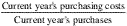

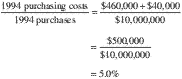
(i) Taxpayer S uses the FIFO method of accounting for inventories. S's beginning inventory for 1994 (all of which was sold during 1994) was $2,100,000 (consisting of $2,000,000 of section 471 costs and $100,000 of additional section 263A costs). During 1994, S makes purchases of $10,000,000. In addition, S incurs purchasing costs of $460,000, storage costs of $110,000, and handling costs of $90,000. S's purchases (section 471 costs) remaining in ending inventory at the end of 1994 are $3,000,000.
(ii) In 1994, S incurs $400,000 of total mixed service costs and $1,000,000 of total labor costs (excluding labor costs included in mixed service costs). In addition, S incurs the following labor costs (excluding labor costs included in mixed service costs): purchasing—$100,000, storage—$200,000, and handling—$200,000. Accordingly, the following mixed service costs must be included in purchasing costs, storage costs, and handling costs as capitalizable mixed service costs: purchasing—$40,000 ([$100,000 divided by $1,000,000] multiplied by $400,000); storage—$80,000 ([$200,000 divided by $1,000,000] multiplied by $400,000); and handling—$80,000 ([$200,000 divided by $1,000,000] multiplied by $400,000).
(iii) S computes its purchasing costs absorption ratio for 1994 as follows:
(iv) S computes its storage and handling costs absorption ratio for 1994 as follows:
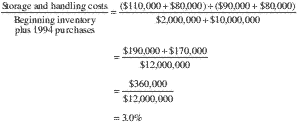
(v) S's combined absorption ratio is 8.0 %, or the sum of the purchasing costs absorption ratio (5.0 %) and the storage and handling costs absorption ratio (3.0 %). Under the simplified resale method, S determines the additional section 263A costs allocable to its ending inventory by multiplying the combined absorption ratio by its section 471 costs with respect to current year's purchases remaining in ending inventory:

(vi) S adds this $240,000 to the $3,000,000 of purchases remaining in its ending inventory to determine its total ending FIFO inventory of $3,240,000.
(i) Taxpayer T uses a dollar-value LIFO inventory method. T's beginning inventory for 1994 is $2,100,000 (consisting of $2,000,000 of section 471 costs and $100,000 of additional section 263A costs). During 1994, T makes purchases of $10,000,000. In addition, T incurs purchasing costs of $460,000, storage costs of $110,000, and handling costs of $90,000. T's 1994 LIFO increment is $1,000,000 ($3,000,000 of section 471 costs in ending inventory less $2,000,000 of section 471 costs in beginning inventory).
(ii) In 1994, T incurs $400,000 of total mixed service costs and $1,000,000 of total labor costs (excluding labor costs included in mixed service costs). In addition, T incurs the following labor costs (excluding labor costs included in mixed service costs): purchasing—$100,000, storage—$200,000, and handling—$200,000. Accordingly, the following mixed service costs must be included in purchasing costs, storage costs, and handling costs as capitalizable mixed service costs: purchasing—$40,000 ([$100,000 divided by $1,000,000] multiplied by $400,000); storage—$80,000 ([ $200,000 divided by $1,000,000] multiplied by $400,000); and handling—$80,000 ([ $200,000 divided by $1,000,000] multiplied by $400,000).
(iii) Based on these facts, T determines that it has a combined absorption ratio of 8.0 %. To determine the additional section 263A costs allocable to its ending inventory, T multiplies its combined absorption ratio (8.0 %) by the $1,000,000 LIFO increment. Thus, T's additional section 263A costs allocable to its ending inventory are $80,000 ($1,000,000 multiplied by 8.0 %). This $80,000 is added to the $1,000,000 to determine a total 1994 LIFO increment of $1,080,000. T's ending inventory is $3,180,000 (its beginning inventory of $2,100,000 plus the $1,080,000 increment).
(iv) In 1995, T sells one-half of the inventory in its 1994 LIFO increment. T must include in its cost of goods sold for 1995 the amount of additional section 263A costs relating to this inventory, i.e., one-half of the $80,000 additional section 263A costs capitalized in 1994 ending inventory, or $40,000.
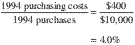
(i) Taxpayer U begins its business in 1994, and adopts the LIFO inventory method. During 1994, U makes purchases of $10,000, and incurs $400 of purchasing costs, $350 of storage costs and $250 of handling costs. U's purchasing costs, storage costs, and handling costs include their proper allocable share of mixed service costs.
(ii) U computes its purchasing costs absorption ratio for 1994, as follows:
(iii) U computes its storage and handling costs absorption ratio for 1994, as follows:
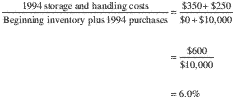
(iv) U's combined absorption ratio is 10%, or the sum of the purchasing costs absorption ratio (4.0%) and the storage and handling costs absorption ratio (6.0%). At the end of 1994, U's ending inventory included $3,000 of current year purchases, contained in three LIFO pools (X, Y, and Z) as shown below. Under the simplified resale method, U computes its ending inventory for 1994 as follows:
| 1994 | Total | X | Y | Z |
|---|---|---|---|---|
| Ending section 471 costs | $3,000 | $1,600 | $600 | $800 |
| Additional section 263A costs (10%) | 300 | 160 | 60 | 80 |
| 1994 ending inventory | 3,300 | 1,760 | 660 | 880 |
(v) During 1995, U makes purchases of $2,000 as shown below, and incurs $200 of purchasing costs, $325 of storage costs and $175 of handling costs. U's purchasing costs, storage costs, and handling costs include their proper share of mixed service costs. Moreover, U sold goods from pools X, Y, and Z having a total cost of $1,000. U computes its ending inventory for 1995 as follows.
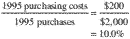
(vi) U computes its purchasing costs absorption ratio for 1995:
(vii) U computes its storage and handling costs absorption ratio for 1995:
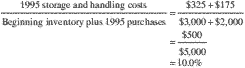
(viii) U's combined absorption ratio is 20.0%, or the sum of the purchasing costs absorption ratio (10.0%) and the storage and handling costs absorption ratio (10.0%).
| 1995 | Total | X | Y | Z |
|---|---|---|---|---|
| Beginning section 471 costs | $3,000 | $1,600 | $600 | $800 |
| 1995 section 471 costs | 2,000 | 1,500 | 300 | 200 |
| Section 471 cost of goods sold | (1,000) | (300) | (300) | (400) |
| 1995 ending section 471 costs | 4,000 | 2,800 | 600 | 600 |
| Consisting of: | ||||
| 1994 layer | 2,800 | 1,600 | 600 | 600 |
| 1995 layer | 1,200 | 1,200 | ||
| 4,000 | 2,800 | 600 | 600 | |
| Additional section 263A costs: | ||||
| 1994 (10%) | 280 | 160 | 60 | 60 |
| 1995 (20%) | 240 | 240 | ||
| 520 | 400 | 60 | 60 | |
| 1995 ending inventory | 4,520 | 3,200 | 660 | 660 |
(ix) In 1995, U experiences a $200 decrement in Pool Z. Thus, U must charge the additional section 263A costs incurred in prior years applicable to the decrement to 1995's cost of goods sold. To do so, U determines a ratio by dividing the decrement by the section 471 costs in the 1994 layer ($200 divided by $800, or 25%). U then multiplies this ratio (25%) by the additional section 263A costs in the 1994 layer ($80) to determine the additional section 263A costs applicable to the decrement ($20). Therefore, $20 is taken into account by U in 1995 as part of its cost of goods sold ($80 multiplied by 25%).

(i) Taxpayer V uses the FIFO method of accounting for inventories and in 1994 elects to use the historic absorption ratio with the simplified resale method. After recomputing its additional section 263A costs in accordance with the transition rules of paragraph (d)(4)(v) of this section, V identifies the following costs incurred during the test period:
1991:
Add'l section 263A costs—$100
Section 471 costs—$3,000
1992:
Add'l section 263A costs—$200
Section 471 costs—$4,000
1993:
Add'l section 263A costs—$300
Section 471 costs—$5,000
(ii) Therefore, V computes a 5% historic absorption ratio determined as follows:

(iii) In 1994, V incurs $10,000 of section 471 costs of which $3,000 remain in inventory at the end of the year. Under the simplified resale method using a historic absorption ratio, V determines the additional section 263A costs allocable to its ending inventory by multiplying its historic ratio (5%) by the section 471 costs remaining in its ending inventory:

(iv) To determine its ending inventory under section 263A, V adds the additional section 263A costs allocable to ending inventory to its section 471 costs remaining in ending inventory ($3,150 = $150 + $3,000). The balance of V's additional section 263A costs incurred during 1994 is taken into account in 1994 as part of V's cost of goods sold.
(v) V's qualifying period ends as of the close of its 1998 taxable year. Therefore, 1999 is a recomputation year in which V must compute its actual combined absorption ratio. V determines its actual absorption ratio for 1999 to be 5.25% and compares that ratio to its historic absorption ratio (5.0%). Therefore, V must continue to use its historic absorption ratio of 5.0% throughout an extended qualifying period, 1999 through 2004 (the recomputation year and the following five taxable years).
(vi) If, instead, V's actual combined absorption ratio for 1999 were not between 4.5% and 5.5%, V's qualifying period would end and V would be required to compute a new historic absorption ratio with reference to an updated test period of 1999, 2000, and 2001. Once V's historic absorption ratio is determined for the updated test period, it would be used for a new qualifying period beginning in 2002.
[T.D. 8482, 58 FR 42224, Aug. 9, 1993; 58 FR 47784, Sept. 10, 1993; 59 FR 3319, Jan. 21, 1994, as amended by T.D. 8559, 59 FR 39962, Aug. 5, 1994, T.D. 9652, 79 FR 2097, Jan. 13, 2014; T.D. 9843, 83 FR 58498, Nov. 20, 2018; T.D. 9942, 86 FR 266, Jan. 5, 2021]
Cross-references
Computed from the citations in the text of 26 CFR.
Code sections it cites
- § 263A Capitalization and inclusion in inventory costs of certain expenses
- § 1221 Capital asset defined
- § 448 Limitation on use of cash method of accounting
- § 267 Losses, expenses, and interest with respect to transactions between related taxpayers
- § 263 Capital expenditures
- § 707 Transactions between partner and partnership
- § 471 General rule for inventories
- § 481 Adjustments required by changes in method of accounting
- § 446 General rule for methods of accounting
Regulations it cites
- § 1.263A-1 Uniform capitalization of costs.
- § 1.263A-2 Rules relating to property produced by the taxpayer.
- § 1.448-2 Limitation on the use of the cash receipts and disbursements method of accounting for taxable years beginning after December 31, 2017.
- § 1.471-3 Inventories at cost.
- § 1.472-8 Dollar-value method of pricing LIFO inventories.
- § 1.6001-1 Records.
Cited by 8 other regulations
- § 1.263A-0 Outline of regulations under section 263A.
- § 1.263A-1 Uniform capitalization of costs.
- § 1.263A-2 Rules relating to property produced by the taxpayer.
- § 1.263A-7 Changing a method of accounting under section 263A.
- § 1.263A-9 The avoided cost method.
- § 1.451-3 Timing of income inclusion for taxpayers with an applicable financial statement using an accrual method of accounting.
- § 1.451-8 Advance payments for goods, services, and certain other items.
- § 1.471-3 Inventories at cost.
Amendment history
From the source citation at the end of the section, newest first. T.D. is a Treasury decision; FR is the Federal Register.
- Amended by T.D. 9942 (86 FR 266)
- Amended by T.D. 9843 (83 FR 58498)
- Amended by T.D. 9652 (79 FR 2097)
- Amended by T.D. 8559 (59 FR 39962)
- Amended (59 FR 3319)
- Amended (58 FR 47784)
- Issued by T.D. 8482 (58 FR 42224)
Where it sits in 26 CFR
- Subchapter A Income tax
- Part 1 Income taxes
- Items Not Deductible
Nearby sections
- § 1.263(f)-1 Reasonable repair allowance.
- § 1.263A-0 Outline of regulations under section 263A.
- § 1.263A-1 Uniform capitalization of costs.
- § 1.263A-2 Rules relating to property produced by the taxpayer.
- § 1.263A-3 Rules relating to property acquired for resale.
- § 1.263A-4 Rules for property produced in a farming business.
- § 1.263A-7 Changing a method of accounting under section 263A.
- § 1.263A-8 Requirement to capitalize interest.
- § 1.263A-9 The avoided cost method.