
Treasury Regulations · 26 CFR
§ 1.585-5. Denial of bad debt reserves for large banks.
Regulation text, no changes From the eCFR, current as of October 15, 2026. The eCFR is an authoritative but unofficial editorial compilation of the Code of Federal Regulations; the official text is the annual CFR on govinfo. Compare it with this section on ecfr.gov (external site) or the official annual CFR on govinfo (external site).
Regulation under 26 U.S.C. § 585
Cite as 26 CFR § 1.585-5
At a glance
Read from the text and its source citation. Not part of the regulation.
- Status
- In the current eCFR
- Issued
- December 29, 1993 by T.D. 8513
- Last amended
- April 1, 1994
- Issued under
- 26 U.S.C. § 585
- Length
- 3,533 words · about 15 min to read
- Cross-references
- cites 11 Code sections and 5 regulations; cited by 4
Bank M, a calendar year taxpayer, is an institution described in § 1.585-1(b)(1)(i). For its taxable year beginning on January 1, 1987, M has average total assets of $600 million. Since M's average total assets for 1987 exceed $500 million, M is a large bank for that year. Pursuant to § 1.585-5(d)(1), 1987 is M's disqualification year. If M maintained a bad debt reserve under section 585 for its immediately preceding taxable year (1986), M must change in 1987 to the specific charge-off method of accounting for bad debts, in accordance with § 1.585-6 or § 1.585-7.
Assume the same facts as in Example 1. Also assume that in 1988 M disposes of a portion of its assets and, as a result, M's average total assets for taxable year 1988 fall to $400 million. M remains a large bank for taxable year 1988 and succeeding taxable years, since its average total assets for a preceding taxable year (1987) beginning after December 31, 1986, exceeded $500 million.
Bank P, a calendar year taxpayer, is an institution described in § 1.585-1(b)(1)(i). P has average total assets of $300 million for its taxable year beginning on January 1, 1988. For the same year, P is a member of a parent-subsidiary controlled group (within the meaning of § 1.585-5(d)(2)) that has average total assets of $800 million. In February 1989, the group sells its stock in P to several individual investors. P is a large bank for taxable year 1988 because it is a member of a group described in § 1.585-5(b)(1)(ii) for that year. P also is a large bank for taxable year 1989 and succeeding taxable years because it was a member of a group described in § 1.585-5(b)(1)(ii) for a preceding taxable year (1988) beginning after December 31, 1986.
Assume the same facts as in Example 3, except that P's stock is purchased by a corporation that is not a large bank under § 1.585-5(b). Also assume that the purchasing corporation elects under section 338 to treat the stock purchase as an asset acquisition. Under section 338, P is considered to have sold all of its assets on the purchase date and is treated as a new corporation that purchased these assets on the next day. Since P is treated as a new corporation, its prior membership in a group described in § 1.585-5(b)(1)(ii) does not cause it to be treated as a large bank for taxable years ending after the date of its sale by the group. However, P may be treated as a large bank because of new membership in such a group or pursuant to § 1.585-5(b)(1)(i) or (b)(2).
Bank Q is a large bank, within the meaning of § 1.585-5(b)(1), for its taxable year beginning on January 1, 1988, and hence for all later years. On March 1, 1989, Q transfers $200 million of its $600 million of assets to Bank R, a newly created subsidiary, in a transaction to which section 351 applies; these assets are R's only assets. On the same day, Q then spins off R in a transaction to which section 355 applies. After these transactions, the shareholders of Q own more than 50 percent of R's outstanding stock. Although R's average total assets do not exceed $500 million, R becomes a large bank on March 1, 1989, pursuant to § 1.585-5(b)(2)(ii). These transactions do not affect Q's status as a large bank.
Bank S is a large bank, within the meaning of § 1.585-5(b)(1)(ii), for its taxable year beginning on January 1, 1987. As a result, S changes to the specific charge-off method of accounting for bad debts in that year. Bank T, which is not a large bank under § 1.585-5(b), uses the reserve method of accounting for bad debts. On June 30, 1988, T acquires substantially all of S's assets in a transaction to which section 381(a) applies. Immediately before the acquisition, S's banking business has total assets of $200 million, and T's has total assets of $250 million. To determine whether T is a large bank under § 1.585-5(b)(2)(iii) for taxable years ending after the acquisition, it is necessary to determine T's principal method of accounting for bad debts with respect to its banking business immediately after the acquisition. This determination requires an application of § 1.381(c)(4)-1(c)(2). For this purpose, T's original and acquired banking businesses are treated as an integrated business. Applying § 1.381(c)(4)-1(c)(2), it is determined that the business's principal method of accounting for bad debts immediately after the acquisition is the reserve method. Hence, the acquisition does not cause T to become a large bank under § 1.585-5(b)(2)(iii).
1st Report Date = B × (R + 1/4Y)
2nd Report Date = B × (R + 1/2Y)
3rd Report Date = B × (R + 3/4Y)
Bank U is a fiscal year taxpayer, and its fiscal year ends on January 31. U reports to its primary Federal regulatory agency as of the last day of the calendar quarter. U does not choose under § 1.585-5(c)(2)(i)(B) a report date more frequent than quarterly. Thus, U's report dates under § 1.585-5(c)(2)(i)(A) are March 31, June 30, September 30, and December 31. For its taxable year beginning on February 1, 1987, U has total assets (within the meaning of § 1.585-5(c)(3)) of $480 million on March 31, $490 million on June 30, $510 million on September 30, and $540 million on December 31. Thus, pursuant to § 1.585-5(c)(1), U's average total assets for its taxable year beginning on February 1, 1987, are $505 million.
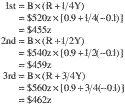
Bank W is a calendar year taxpayer, and its report date (within the meaning of § 1.585-5(c)(2)(i)(A)) is the last day of the calendar quarter. Pursuant to § 1.585-5(c)(4), W chooses to estimate the tax bases of its assets for 1990. Therefore, W must estimate the tax bases of all of its assets (other than cash) for its first three report dates in 1990. Since W's fourth report date (December 31) is the last day of its taxable year, the tax bases of its assets may not be estimated for this date. The adjusted tax bases ofall of W's assets (other than cash) are $450z on December 31, 1989, and $480z on December 31, 1990. The book bases of those assets are $500z on December 31, 1989; $520z on March 31, 1990; $540z on June 30, 1990; $560z on September 30, 1990; and $600z on December 31, 1990. Applying the formulas provided in § 1.585-5(c)(4)(ii), W's tax/book ratio as of the close of 1989 (R), is 0.9 (450z/500z). W's tax/book ratio as of the close of 1990 is 0.8 (480z/600z). Thus, Y is −0.1. The estimated adjusted tax bases of all of W's assets (other than cash) on the first three report dates of 1990 are as follows:
Bank X is a large bank within the meaning of § 1.585-5(b)(1)(i). Bank Y is not a large bank under § 1.585-5(b), and it maintains a bad debt reserve under section 585. In 1988, X purchases all of the stock of Y. If the acquisition causes Y to become a member of a parent-subsidiary controlled group described in § 1.585-5(b)(1)(ii), Y is a large bank beginning in its first taxable year that ends after the date of the acquisition. Pursuant to § 1.585-5(d)(1), this year is Y's disqualification year. Y must change in this year to the specific charge-off method of accounting for bad debts, in accordance with § 1.585-6 or § 1.585-7.
[T.D. 8513, 58 FR 68757, Dec. 29, 1993; 59 FR 15502, Apr. 1, 1994]
Cross-references
Computed from the citations in the text of 26 CFR.
Code sections it cites
- § 585 Reserves for losses on loans of banks
- § 166 Bad debts
- § 593 Reserves for losses on loans
- § 267 Losses, expenses, and interest with respect to transactions between related taxpayers
- § 355 Distribution of stock and securities of a controlled corporation
- § 381 Carryovers in certain corporate acquisitions
- § 338 Certain stock purchases treated as asset acquisitions
- § 351 Transfer to corporation controlled by transferor
- § 1012 Basis of property—cost
- § 882 Tax on income of foreign corporations connected with United States business
- § 1563 Definitions and special rules
Regulations it cites
- § 1.585-7 Elective cut-off method of changing from the reserve method of section 585.
- § 1.585-6 Recapture method of changing from the reserve method of section 585.
- § 1.585-1 Reserve for losses on loans of banks.
- § 1.381(c)(4)-1 Method of accounting.
- § 1.882-5 Determination of interest deduction.
Cited by 4 other regulations
Amendment history
From the source citation at the end of the section, newest first. T.D. is a Treasury decision; FR is the Federal Register.
- Amended (59 FR 15502)
- Issued by T.D. 8513 (58 FR 68757)
Where it sits in 26 CFR
- Subchapter A Income tax
- Part 1 Income taxes
- Banking Institutions
Nearby sections
- § 1.585-1 Reserve for losses on loans of banks.
- § 1.585-2 Addition to reserve.
- § 1.585-3 Special rules.
- § 1.585-4 Reorganizations and asset acquisitions.
- § 1.585-5 Denial of bad debt reserves for large banks.
- § 1.585-6 Recapture method of changing from the reserve method of section 585.
- § 1.585-7 Elective cut-off method of changing from the reserve method of section 585.
- § 1.585-8 Rules for making and revoking elections under §§ 1.585-6 and 1.585-7.