
Treasury Regulations · 26 CFR
§ 1.614-6. Rules applicable to basis, holding period, and abandonment losses where mineral interests have been aggregated or combined.
Regulation text, no changes From the eCFR, current as of October 15, 2026. The eCFR is an authoritative but unofficial editorial compilation of the Code of Federal Regulations; the official text is the annual CFR on govinfo. Compare it with this section on ecfr.gov (external site) or the official annual CFR on govinfo (external site).
Regulation under 26 U.S.C. § 614
Cite as 26 CFR § 1.614-6
At a glance
Read from the text and its source citation. Not part of the regulation.
- Status
- In the current eCFR
- Issued
- January 10, 1961 by T.D. 6524
- Last amended
- November 3, 1980 by T.D. 7728
- Issued under
- 26 U.S.C. § 614
- Length
- 4,860 words · about 21 min to read
- Cross-references
- cites 4 Code sections and 4 regulations; cited by 7
(a) The unadjusted bases of all such interests which have never been included in an aggregation; and
(b) The adjusted bases of all such interests which at some time have been included in an aggregation, as of the date on which they ceased to participate in an aggregation
adjusted by the total of all adjustments to the bases of the several mineral interests combined, as required by section 1016,
(c) In the case of interests described in (a), for the entire period of the taxpayer's ownership of such interest; and
(d) In the case of interests described in (b), for the period, if any, between the time of deaggregation and the time of combination.
Thereafter, the adjustments to basis required by section 1016 shall apply to the total adjusted basis of the combined property for all purposes of subtitle A of the Code.
(b) If, for any taxable year after the first taxable year for which an aggregation under section 614(b) (prior to its amendment by section 226(a) of the Revenue Act of 1964), (c), or (e) is effective:
then the adjusted basis of the aggregated property as of the first day of the first taxable year for which such termination or change is effective shall be apportioned to determine the adjusted bases of the resultant separate mineral interests, as of such first day, for purposes of computing gain or loss, depletion, and for all other purposes of subtitle A of the Code. The adjusted bases of such separate mineral interests shall be determined by apportioning the adjusted basis of the aggregated property (as of the first day of the first taxable year for which such termination or change is effective) between or among such interests in the same proportion as the fair market value of each such interest (as of such first day) bears to the total fair market value of the aggregated property as of such first day. For the purpose of determining the adjusted bases of the separate mineral interests, the adjusted basis of the aggregated property (from which the adjusted basis of each separate mineral interest is determined) shall not be reduced below zero.
(b) Allocation of adjustments method. (i) The taxpayer may elect to determine basis by an allocation of adjustments in lieu of the fair market value method prescribed in (a) of this subdivision (ii). In such a case, the adjusted basis (as of the first day of the first taxable year beginning after December 31, 1963) of each interest which was participating in an aggregation of operating mineral interests on the day preceding such first day is the unadjusted basis of such interest immediately after its acquisition by the taxpayer, adjusted by the total of all adjustments to its basis as required by section 1016 to the effective date of aggregation, and by that portion of those section 1016 adjustments to the basis of the aggregation which is reasonably attributable to such interest. For this purpose, two or more interests which are being combined upon deaggregation shall be treated as one interest. An adjustment to the basis of the aggregation is reasonably attributable to such interest to the extent that the adjustment thereto resulted from inclusion of the interest in the aggregation, even though such interest would not have been entitled to the adjustment to the same extent if such interest had been treated separately because of the 50 percent of taxable income limitation or for any other reason. In a case in which the amount of a percentage depletion deduction which was allowed with respect to an aggregation was limited by the 50 percent of taxable income limitation of section 613(a), the portion of such amount which is attributable to each of the interests in the aggregation shall be determined by multiplying such amount by a fraction, the numerator of which is the gross income from such interest and the denominator of which is the gross income from the aggregation. The determination as to which property a particular adjustment is attributable may be based upon records of production or any other facts which establish the reasonableness of the determination. See example 6 of subparagraph (3) of this paragraph.
A taxpayer owning three operating mineral interests, designated Nos. 1, 2, and 3, within a single operating unit, properly elects to aggregate such properties under section 614(b) for the calendar year 1954 in his income tax return filed on April 15, 1955. The unadjusted bases and adjustments under section 1016 for depletion through December 31, 1953, in respect of such properties are as follows:
| Unadjusted basis | Adjustments under Section 1016 | |
|---|---|---|
| No. 1 | $25,000 | $27,000 |
| No. 2 | 18,000 | 10,000 |
| No. 3 | 15,000 | 4,000 |
| Total | 58,000 | 41,000 |
The adjusted basis of the aggregated property as of January 1, 1954, is $17,000 ($58,000-$41,000).
Assume the same facts as in example 1, except that a portion of the aggregated property is sold on June 1, 1956, for $15,000 which is also the fair market value of such portion on the date of sale. In order to determine the gain or loss from this sale as well as the adjusted basis of the retained property, an apportionment must be made. The aggregated property had a fair market value of $25,000 on the date of sale. From January 1, 1954, through May 31, 1956, $10,000 of depletion has been allowed with respect to the aggregated property. The adjusted basis of the portion sold is determined as follows:

Therefore, the gain on this sale of the portion sold is $10,800 ($15,000-$4,200). The adjusted basis of the property retained is $2,800 ($7,000-$4,200).
Assume the same facts as in example 2, except that instead of selling, the taxpayer subleases one of the leases making up the aggregated property, retaining a one-eighth royalty interest therein. The fair market value of such lease is $15,000 on the date of the sublease. The adjusted basis of such royalty interest is $4,200 which is computed as follows:

In 1953, a taxpayer owned mineral interests Nos. 1, 2, and 3 which he operated as a unit. He owned no other operating interests during that year. The unadjusted bases of these properties were $10,000, $15,000, and $20,000, respectively, and depletion allowed through December 31, 1953, was $5,000 with respect to each property. The taxpayer operated these properties during the year 1954 and, in addition, operated as part of the unit mineral interest No. 4 which he acquired on July 1, 1954, on which date he made the first exploration expenditure with respect thereto. He paid $20,000 for No. 4. In his return for the calendar year 1954, the taxpayer elected under section 614(b) to aggregate all of these mineral interests. The taxpayer must compute cost depletion for the calendar year 1954 on the basis of an aggregated property with an adjusted basis of $30,000 ($45,000-$15,000) for the period from January 1 to June 30, and with an adjusted basis of $50,000 (less depletion for the first six months) for the period from July 1 to December 31. If applicable, the taxpayer must compute percentage depletion on the basis of gross income and taxable income from the aggregated property for the entire year, including the gross income and deductions with respect to operating mineral interest No. 4 for the period from July 1 to December 31. If a portion of the aggregated property is sold during the first six months, its adjusted basis must be determined at the time of sale with an adjustment for depletion to the date of sale. If percentage depletion is applicable, it must be allocated on an equitable basis to the periods prior and subsequent to the date of sale in order to determine the adjustment for depletion to the date of sale.
A taxpayer owns two operating mineral interests in oil wells, designated Nos. 1 and 2, in tract A, and another such interest, designated No. 3, in tract B. All three interests are in the same operating unit (as defined in paragraph (c) of § 1.614-2). The taxpayer, who is on a calendar year basis, has properly elected under § 1.614-2 to aggregate such interests for the calendar years 1954 through 1963. The unadjusted bases and adjustments under section 1016 for depletion through December 31, 1953, in respect of such interests are as follows:
| Unadjusted basis | Adjustments under section 1016 | |
|---|---|---|
| No. 1 | $42,000 | $11,000 |
| No. 2 | 37,000 | 4,000 |
| No. 3 | 19,000 | 23,000 |
| Total | 98,000 | 38,000 |
The adjusted basis of the aggregated property as of January 1, 1954, is therefore $60,000 ($98,000 minus $38,000). The taxpayer properly elects under section 614(b) and § 1.614-8 to treat Nos. 1 and 2 as separate properties for the calendar year 1964 and thereafter and does not elect to use the allocation of adjustments method of determining basis provided in subparagraph (2) (ii) (b) of this paragraph. No. 3 will be treated as a separate property, also, because it is in a different tract than the taxpayer's other interests. From January 1, 1954, through December 31, 1963, $50,000 of depletion has been allowed with respect to the aggregated property, leaving an adjusted basis of $10,000 ($60,000 minus $50,000) on January 1, 1964. On December 31, 1963, the aggregated property has a fair market value of $40,000. Nos. 1, 2, and 3 have fair market values of $16,000, $22,000, and $2,000, respectively. Accordingly, the adjusted bases of Nos. 1, 2, and 3 on January 1, 1964, are $4,000,
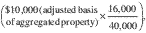
$5,500 [$10,000 × (22,000/40,000)], and
$500 [$10,000 × (2,000/40,000)] respectively.
A taxpayer owns four operating mineral interests in oil wells, designated Nos. 1, 2, 3, and 4. All four interests are in the same operating unit and the same tract or parcel of land. The taxpayer, who is on a calendar year basis, has properly elected under § 1.614-2 to aggregate such interests for the calendar years 1954 through 1963. The taxpayer properly elects under section 614(b) and paragraph (a) of § 1.614-8 to treat Nos. 1 and 2 as separate properties for the calendar year 1964 and thereafter. The taxpayer also properly elects to use the allocation of adjustments method of determining basis as provided in subparagraph (2) (ii) (b) of this paragraph. The unadjusted bases of Nos. 1, 2, and combined 3 and 4, the adjustments attributable to each, and the deaggregated basis of each (prior to further adjustment as provided in subparagraph (2) (ii) (b)(ii) of this paragraph) are as follows:
| Basis upon acquisition | Adjustments to time of aggregation | Attributable adjustments during aggregation | Basis upon deaggregation after first adjustment | |
|---|---|---|---|---|
| No. 1 | $35,000 | $1,000 | $16,000 | $18,000 |
| No. 2 | 30,000 | 11,000 | 23,000 | 0 |
| No. 3 | 25,000 | 3,000 | 5,000 | |
| No. 4 | 10,000 | 12,000 | 9,000 | 6,000 |
| Total | 100,000 | 27,000 | 53,000 | 24,000 |
The total of the adjusted bases (prior to further adjustment) of the interests which were included in the aggregation is $24,000 while the adjusted basis of the aggregation is $20,000 ($100,000 minus the sum of $27,000 and $53,000). Therefore, the adjusted bases of the interests are further reduced by $4,000 ($24,000 minus $20,000). The adjusted basis of No. 1 of $18,000 is further reduced by $3,000 [$4,000 × (18,000 ÷ 24,000)] to $15,000. Similarly, the adjusted basis of combined Nos. 3 and 4 of $6,000 is further reduced by $1,000 [$4,000 × (6,000 ÷ 24,000)] to $5,000. Assume further that the taxpayer also owns interest No. 5 in the same tract or parcel of land, that such interest was not a part of any aggregation, that such interest had a basis of $15,000 upon acquisition and had subsequent adjustments in reduction of basis totalling $17,000, and that the taxpayer does not elect to treat such interest as a separate property. In such case, Nos. 3, 4, and 5 will be combined. The combination will have an adjusted basis of $3,000, determined by adding the unadjusted basis of No. 5 ($15,000) and the adjusted bases of combined Nos. 3 and 4 upon deaggregation ($5,000), and subtracting from the total thereof ($20,000) the adjustments to No. 5 ($17,000).
and such sum shall be adjusted by the total of all adjustments to the bases of the several mineral interests aggregated as required by section 1016 to the effective date of aggregation. For the purpose of determining loss, the adjusted basis of the aggregated property on the effective date of aggregation shall be the sum of:
and such sum shall be adjusted by the total of all adjustments to the bases of the several mineral interests aggregated as required by section 1016 to the effective date of aggregation. Thereafter, the adjustments to basis required by section 1016 shall apply to the total adjusted basis of the aggregated property for all purposes of the Code. Upon disposition of a part of the aggregated property, or upon termination of the aggregation for any reason, or upon change in the treatment of any mineral interests in the aggregation with consent of the Commissioner, the adjusted basis for determining gain and the adjusted basis for determining loss with respect to each resultant part of the aggregated property shall be determined in accordance with subparagraph (2) of this paragraph. The provisions of this subparagraph may be illustrated by the following examples:
At the close of 1953 a taxpayer owned two operating mineral interests designated as Nos. 1 and 2 in the same operating unit. Operating mineral interest No. 1 was acquired by the taxpayer before March 1, 1913, and on such date its basis with reference to its fair market value was $50,000 and its adjusted basis with reference to its cost was $44,000. The unadjusted basis of operating mineral interest No. 2, acquired after March 1, 1913, was $30,000. Adjustments under section 1016 for depletion from March 1, 1913, through December 31, 1953, were $37,000 for operating mineral interest No. 1 and $20,000 for operating mineral interest No. 2. Assume that the taxpayer elected for the taxable year 1954 to aggregate operating mineral interests Nos. 1 and 2. The adjusted basis of the aggregated property as of January 1, 1954, for the purpose of determining gain would be $23,000 ($50,000 plus $30,000) minus ($37,000 plus $20,000). For the purpose of determining loss, the adjusted basis would be $17,000 ($44,000 plus $30,000) minus ($37,000 plus $20,000).
Assume the same facts as in example 1 and further assume that for the taxable years 1954 and 1955, the taxpayer was allowed $5,000 of depletion on the aggregated property, that on January 1, 1956, he sold a portion of the aggregated property for $20,000, and that, as of January 1, 1956, the aggregated property had a fair market value of $24,000. At the time of sale, the adjusted basis of the aggregated property for the purpose of determining gain was $18,000 ($23,000-$5,000); and the adjusted basis for the purpose of determining loss was $12,000 ($17,000-$5,000). The adjusted basis of the portion sold would be computed as follows:

Taxpayer's gain would then be computed as follows:
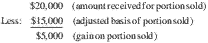
The adjusted basis of the portion retained as of January 1, 1956, for the purpose of determining gain is $3,000 ($18,000-$15,000). For the purpose of determining loss, the adjusted basis is $2,000 ($12,000-$10,000).
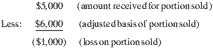
Assume the same facts as in example 2, except that a portion of the aggregated property was sold for $5,000 and that the fair market value of the aggregated property at the time of sale was $10,000. The adjusted basis of the portion sold would be computed as follows:

Taxpayers loss would then be computed as follows:
and such sum shall be adjusted by the total of all adjustments to the bases of the mineral interests as required by section 1016 to the effective date of combination. For the purpose of determining loss, the adjusted basis of the combined property on the effective date of combination shall be the sum of:
and such sum shall be adjusted by the total of all adjustments to the bases of the mineral interests as required by section 1016 to the effective date of combination. Thereafter, the adjustments to basis required by section 1016 shall apply to the total adjusted basis of the combined property for all purposes of the Code. Upon disposition of a part of the combined property, the adjusted basis for determining gain and the adjusted basis for determining loss with respect to each resultant part of the combined property shall be determined in accordance with subparagraph (2) of this paragraph.
Taxpayer A owns operating mineral interests Nos. 1, 2, and 3. He acquired interests Nos. 1 and 2 in 1953 but purchased and made development expenditures on interest No. 3 on December 1, 1954. In his return for the taxable year 1954, taxpayer A elects to aggregate interests Nos. 1, 2, and 3 which are operated as a unit. On May 1, 1955, taxpayer A sells the north half of the aggregated property which includes portions of interests Nos. 1, 2, and 3. The sales price of the north half was $80,000; the adjusted basis of the aggregated property as of the date of sale was $20,000; and the fair market value of the aggregated property as of the date of sale was $100,000. The adjusted basis applicable to the north half is computed as follows:

The total gain on the sale is $64,000 ($80,000−$16,000).
The gain attributable to the sale of the portion held for six months or less is computed as follows (assuming that the fair market value of the portion of No. 3 included in the sale as of the date of sale was $30,000):

The gain on the portion of No. 3 sold is $24,000 ($30,000-$6,000).
[T.D. 6524, 26 FR 159, Jan. 10, 1961, as amended by T.D. 6859, 30 FR 13701, Oct. 28, 1965; T.D. 7728, 45 FR 72650, Nov. 3, 1980]
Cross-references
Computed from the citations in the text of 26 CFR.
Code sections it cites
Regulations it cites
- § 1.614-2 Election to aggregate separate operating mineral interests under section 614(b) prior to its amendment by Revenue Act of 1964.
- § 1.614-8 Elections with respect to separate operating mineral interests for taxable years beginning after December 31, 1963, in the case of oil and gas wells.
- § 1.614-3 Rules relating to separate operating mineral interests in the case of mines.
- § 1.614-5 Special rules as to aggregating nonoperating mineral interests.
Cited by 7 other regulations
- § 1.613-5 Taxable income from the property.
- § 1.614-1 Definition of property.
- § 1.614-2 Election to aggregate separate operating mineral interests under section 614(b) prior to its amendment by Revenue Act of 1964.
- § 1.614-3 Rules relating to separate operating mineral interests in the case of mines.
- § 1.614-4 Treatment under the Internal Revenue Code of 1939 with respect to separate operating mineral interests for taxable years beginning before January 1, 1964, in the case of oil and gas wells.
- § 1.614-5 Special rules as to aggregating nonoperating mineral interests.
- § 1.614-8 Elections with respect to separate operating mineral interests for taxable years beginning after December 31, 1963, in the case of oil and gas wells.
Amendment history
From the source citation at the end of the section, newest first. T.D. is a Treasury decision; FR is the Federal Register.
- Amended by T.D. 7728 (45 FR 72650)
- Amended by T.D. 6859 (30 FR 13701)
- Issued by T.D. 6524 (26 FR 159)
Where it sits in 26 CFR
- Subchapter A Income tax
- Part 1 Income taxes
- Natural Resources
Nearby sections
- § 1.614-2 Election to aggregate separate operating mineral interests under section 614(b) prior to its amendment by Revenue Act of 1964.
- § 1.614-3 Rules relating to separate operating mineral interests in the case of mines.
- § 1.614-4 Treatment under the Internal Revenue Code of 1939 with respect to separate operating mineral interests for taxable years beginning before January 1, 1964, in the case of oil and gas wells.
- § 1.614-5 Special rules as to aggregating nonoperating mineral interests.
- § 1.614-6 Rules applicable to basis, holding period, and abandonment losses where mineral interests have been aggregated or combined.
- § 1.614-7 Extension of time for performing certain acts.
- § 1.614-8 Elections with respect to separate operating mineral interests for taxable years beginning after December 31, 1963, in the case of oil and gas wells.
- § 1.615-1 Pre-1970 exploration expenditures.
- § 1.615-2 Deduction of pre-1970 exploration expenditures in the year paid or incurred.