
Treasury Regulations · 26 CFR
§ 1.72-7. Adjustment in investment where a contract contains a refund feature.
Regulation text, no changes From the eCFR, current as of October 15, 2026. The eCFR is an authoritative but unofficial editorial compilation of the Code of Federal Regulations; the official text is the annual CFR on govinfo. Compare it with this section on ecfr.gov (external site) or the official annual CFR on govinfo (external site).
Regulation under 26 U.S.C. § 72
Cite as 26 CFR § 1.72-7
At a glance
Read from the text and its source citation. Not part of the regulation.
- Status
- In the current eCFR
- Issued
- November 26, 1960 by T.D. 6500
- Last amended
- December 19, 1986 by T.D. 8115
- Issued under
- 26 U.S.C. § 72
- Length
- 4,353 words · about 19 min to read
- Cross-references
- cites 1 Code section and 6 regulations; cited by 4
The resulting amount is the investment in the contract adjusted for the present value of the refund feature without discount for interest and is to be used in determining the exclusion ratio to be applied to the payments received as an annuity. The percentage found in Tables III or VII shall not be adjusted in a manner described in paragraph (a)(2) of § 1.72-5. These principles may be illustrated by the following examples:
On January 1, 1954, a husband, age 65, purchased for $21,053, an immediate installment refund annuity payable $100 per month for life. The contract provided that in the event the husband did not live long enough to recover the full purchase price, payments were to be made to his wife until the total payments under the contract equaled the purchase price. The investment in the contract adjusted for the purpose of determining the exclusion ratio is computed in the following manner:
| Cost of the annuity contract (investment in the contract, unadjusted) | $21,053 |
| Amount to be received annually | $1,200 |
| Number of years for which payment guaranteed ($21,053 divided by $1,200) | 17.5 |
| Rounded to nearest whole number of years | 18 |
| Percentage located in Table III for age 65 (age of the annuitant as of the annuity starting date) and 18 (the number of whole years) (percent) | 30 |
| Subtract value of the refund feature to the nearest dollar (30 percent of $21,053) | $6,316 |
| Investment in the contract adjusted for the present value of the refund feature without discount for interest | $14,737 |
Assume the same facts as in example (1), except that the total investment in the contract was made after June 30, 1986. The investment in the contract adjusted for the purpose of determining the exclusion ratio is computed as follows:
| Cost of the annuity contract (investment in the contract, unadjusted) | $21,053 |
| Amount to be received annually | $1,200 |
| Number of years for which payment guaranteed ($21,053 ÷ $1,200) | 17.5 |
| Rounded to nearest whole number of years | 18 |
| Percentage in Table VII for age 65 and 18 years (percent) | 15 |
| Subtract value of the refund feature to the nearest dollar (15 percent of $21,053) | $3,158 |
| Investment in the contract adjusted for the present value of the refund feature without discount for interest | $17,895 |
Assume the same facts as in example (1), except that the pre-July 1986 investment in the contract is $10,000 and the post-June 1986 investment in the contract is $11,053. If the annuitant makes the election described in § 1.72-6(d)(6), separate computations must be performed pursuant to § 1.72-6(d) to determine the adjusted investment in the contract. The pre-July 1986 investment in the contract and the post-June 1986 investment in the contract adjusted for the purpose of determining the exclusion ratios are, respectively, $7,000 and $9,395, determined as follows:
| Pre-July 1986 investment in the contract (unadjusted) | $10,000 |
| Pre-July 1986 portion of the amount to be received annually ($10,000/$21,053 × $1,200) | $570.00 |
| Number of years for which payment guaranteed ($10,000 ÷ $570) | 17.50 |
| Rounded to nearest whole number of years | 18 |
| Percentage in Table III for age 65 and 18 years (percent) | 30 |
| Subtract value of the refund feature to the nearest dollar (30 percent of $10,000) | $3,000 |
| Pre-July 1986 investment in the contract adjusted for the present value of the refund feature without discount for interest | $7,000 |
| Post-June 1986 investment in the contract (unadjusted) | $11,053 |
| Post-June 1986 portion of the amount to be received annually ($11,053/$21,053 × $1,200) | $630 |
| Number of years for which payment guaranteed ($11,053 ÷ $630) | 17.54 |
| Rounded to nearest whole number of years | 18 |
| Percentage in Table VII for age 65 and 18 years (percent) | 15 |
| Subtract value of the refund feature to the nearest dollar (15 percent of $11,053) | $1,658 |
| Post-June 1986 investment in the contract adjusted for the present value of the refund feature without discount for interest | $9,395 |
If, in the above examples, the guaranteed amount had exceeded the investment in the contract (or applicable portion thereof), the percentage found in Table III or VII (whichever is applicable) should have been applied to the lesser of these amounts since any excess of the guaranteed amount over the investment in the contract (as found under § 1.72-6) would not have constituted a refund of premiums or other consideration paid. In such a case, however, a different multiple might have been obtained from Table III or VII (whichever is applicable) since the number of years for which payments were guaranteed would have been greater.
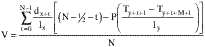
In which:
V = The percentage, rounded to the nearest whole percent,
x = The age at the nearest birthday of the primary annuitant,
y = The age at the nearest birthday of the survivor annuitant,
N = The guaranteed amount divided by the annual annuity payable to the primary annuitant, rounded to the nearest integer,
P = The annual annuity continued to the survivor annuitant divided by the annual annuity payable to the primary annuitant,
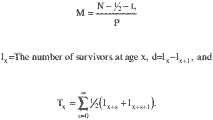
In the case of a contract providing for payments to be made to two persons in the manner described in paragraph (b)(6) of § 1.72-5, this paragraph (c)(1) is applied as though the older person were the primary annuitant and the younger person were the survivor annuitant. For purposes of this paragraph (c)(1), the number of survivors at agex (lx) is determined under the following table:
| x | lx |
|---|---|
| 5 | 1000000. |
| 6 | 999729. |
| 7 | 999493. |
| 8 | 999284. |
| 9 | 999069. |
| 10 | 998849. |
| 11 | 998620. |
| 12 | 998382. |
| 13 | 998135. |
| 14 | 997876. |
| 15 | 997606. |
| 16 | 997322. |
| 17 | 997025. |
| 18 | 996714. |
| 19 | 996387. |
| 20 | 996044. |
| 21 | 995684. |
| 22 | 995304. |
| 23 | 994905. |
| 24 | 994484. |
| 25 | 994041. |
| 26 | 993573. |
| 27 | 993080. |
| 28 | 992563. |
| 29 | 992024. |
| 30 | 991461. |
| 31 | 990876. |
| 32 | 990269. |
| 33 | 989638. |
| 34 | 988984. |
| 35 | 988303. |
| 36 | 987593. |
| 37 | 986846. |
| 38 | 986055. |
| 39 | 985210. |
| 40 | 984298. |
| 41 | 983310. |
| 42 | 982230. |
| 43 | 981046. |
| 44 | 979742. |
| 45 | 978302. |
| 46 | 976709. |
| 47 | 974945. |
| 48 | 972992. |
| 49 | 970832. |
| 50 | 968447. |
| 51 | 966000. |
| 52 | 963313. |
| 53 | 960375. |
| 54 | 957175. |
| 55 | 953705. |
| 56 | 949954. |
| 57 | 945912. |
| 58 | 941568. |
| 59 | 936908. |
| 60 | 931903. |
| 61 | 926451. |
| 62 | 920540. |
| 63 | 914090. |
| 64 | 907011. |
| 65 | 899221. |
| 66 | 890428. |
| 67 | 880797. |
| 68 | 870298. |
| 69 | 858904. |
| 70 | 846565. |
| 71 | 832316. |
| 72 | 816861. |
| 73 | 800078. |
| 74 | 781837. |
| 75 | 762012. |
| 76 | 740743. |
| 77 | 717689. |
| 78 | 692780. |
| 79 | 665977. |
| 80 | 637260. |
| 81 | 607339. |
| 82 | 575531. |
| 83 | 541919. |
| 84 | 506647. |
| 85 | 469931. |
| 86 | 432459. |
| 87 | 394138. |
| 88 | 355393. |
| 89 | 316712. |
| 90 | 278663. |
| 91 | 242020. |
| 92 | 207150. |
| 93 | 174602. |
| 94 | 144828. |
| 95 | 118151. |
| 96 | 94871.7 |
| 97 | 74863.6 |
| 98 | 58042.2 |
| 99 | 44176.1 |
| 100 | 32956.4 |
| 101 | 24044.8 |
| 102 | 17104.1 |
| 103 | 11815.5 |
| 104 | 7886.75 |
| 105 | 5054.94 |
| 106 | 3086.95 |
| 107 | 1778.82 |
| 108 | 955.465 |
| 109 | 470.955 |
| 110 | 208.668 |
| 111 | 80.7899 |
| 112 | 26.2340 |
| 113 | 6.69620 |
| 114 | 1.19385 |
| 115 | .111460 |
| Number of years difference in age (2 male annuitants or 2 female annuitants) | Addition to older age in years |
|---|---|
| 0 to 1, inclusive | 9 |
| 2 to 3, inclusive | 8 |
| 4 to 5, inclusive | 7 |
| 6 to 8, inclusive | 6 |
| 9 to 11, inclusive | 5 |
| 12 to 15, inclusive | 4 |
| 16 to 20, inclusive | 3 |
| 21 to 27, inclusive | 2 |
| 28 to 42, inclusive | 1 |
| Over 42 | 0 |
Prior to July 1, 1986, Taxpayer A, a 70-year-old male, purchases a joint and last survivor annuity for $33,050. The contract provides for payments of $100 a month to be paid first to himself for life and then to B, his 40-year-old daughter, if she survives him. The contract further provides that in the event both die before ten years' payments have been made, payments will be continued to C, a beneficiary, or to C's estate, until ten years' payments have been made. If there is no post-June 1986 investment in the contract, the investment in the contract adjusted for the purpose of determining the exclusion ratio is computed in the following manner:
| Cost of the annuity contract (investment in the contract unadjusted) | $33,050 |
| Guaranteed amount ($1,200 × 10) | $12,000 |
| Percentage in Table III for male, age 70 (or female, age 75) for duration of the guarantee (10) | 21 |
| Percentage in Table III for female, age 40 (or male, age 35) for duration of the guarantee (10) | 2 |
| Sum of percentages obtained | 23 |
| Difference in years of age between two males, aged 70 and 35 (or 2 females, aged 75 and 40) | 35 |
| Addition, in years, to older age | 1 |
| Percentage in Table III for male one year older than A | 22 |
| Difference between percentages obtained (23 percent less 22 percent) | 1 |
| Value of the refund feature to the nearest dollar (1 percent of $12,000) | $120 |
| Investment in the contract adjusted for present value of the refund feature | $32,930 |
The facts are the same as in example (1), except that the total investment in the contract was made after June 30, 1986, A is 73 years of age, and B is A's 70 year old spouse. The percentage determined under the formula in paragraph (c)(1)(i) of this section is two percent. Thus, the amount determined under paragraph (c)(1)(ii) of this section is $240 (2 percent of $12,000), and the investment in the contract adjusted for the present value of the refund feature is $32,810 ($33,050—$240).
Taxpayer A, a 50-year-old male purchases for $25,000 a contract which provides for variable monthly payments to be paid to him for his life. The contract also provides that if he should die before receiving payments for fifteen years, payments shall continue according to the original formula to his estate or beneficiary until payments have been made for that period. Beginning with the month of September, A receives payments which total $450 for the first taxable year of receipt. This amount, placed on an annual basis, is $1,350 ($450 divided by 4, or $112.50; $112.50 multiplied by 12, or $1,350). If there is no post-June 1986 investment in the contract, the guaranteed amount is considered to be $20,250 ($1,350 × 15), and the multiple from Table III (found in the same manner as in paragraph (b) of this section), 9 percent, applied to $20,250 (since this amount is less than the investment in the contract), results in a refund adjustment of $1,822,50. The latter amount, subtracted from the investment in the contract of $25,000, results in an adjusted investment in the contract of $23,177.50. If A dies before receiving payments for 15 years and the remaining payments are made to B, his beneficiary, B shall exclude the entire amount of such payments from his gross income until the amounts so received by B, together with the amount received by A and excludable from A's gross income, equal or exceed $25,000. Any excess and any payments thereafter received by B shall be fully includible in gross income.
Assume the same facts as in example (1), except that the total investment in the contract was made after June 30, 1986. The applicable multiple found in Table VII is 3 percent. When this is applied to the guaranteed amount of $20,250, it results in a refund adjustment of $607.50. The adjusted investment in the contract in $24,392.50 ($25,000—$607.50).
If taxpayer A, an insured 70 years of age, upon maturity of an endowment policy which cost him a net amount of $86,000, elected a dual settlement consisting of (1) monthly payments for his life aggregating $4,146 per year with 10 years' payments certain, and (2) monthly payments for his 60-year-old brother, B, aggregating $2,820 per year with 20 years' payments certain, the exclusion ratio to be used by both A and B if there is no post-June 1986 investment in the contract would be determined in the following manner:
| A's expected return (A's payments per year of $4,146 multiplied by his life expectancy from Table 1 of 12.1) | $50,166.60 |
| B's expected return (B's payments per year of $2,820 multiplied by his life expectancy from Table 1 of 18.2) | $51,324.00 |
| Sum of expected returns to be used in determining exclusion ratio | $101,490.60 |
| Percentage of total expected return attributable to A's expectancy of life ($50,166.60 ÷ $101,490.60) | 49.4 |
| Percentage of total expected return attributable to B's expectancy of life ($51,324 ÷ $101,490.60) | 50.6 |
| Portion of investment in the contract allocable to A's annuity (49.4 percent of $86,000) | $42,484.00 |
| Portion of investment in the contract allocable to B's annuity (50.6 percent of $86,000) | $43,516.00 |
| Value of the refund feature with respect to A's annuity (percentage from Table III for male, age 70, and duration 10, or 21 percent, multiplied by lesser of guaranteed amount and allocable portion of investment in the contract, $41,460) | $8,707.00 |
| A's allocable portion of the investment in the contract adjusted for refund feature ($42,484 less $8,707.00) | $33,777.00 |
| Value of the refund feature with respect to B's annuity (percentage from Table III for male, age 60, and duration 20, or 25 percent, multiplied by lesser of guaranteed amount and allocable portion of investment in the contract, $43,516) | $10,879.00 |
| B's allocable portion of the investment in the contract adjusted for refund feature ($43,516 less $10,879.00) | $32,637.00 |
| Sum of A's and B's allocable portions of the investment in the contract after adjustment for the refund feature | $66,414.00 |
| Exclusion ratio for the contract as a whole (total adjusted investment in the contract, $66,414, divided by the total expected return from above, $101,490.60) (percent) | 65.4 |
Assume the same facts as in example (1) except that the total investment in the contract was made after June 30, 1986. The exclusion ratio to be used by both A and B would be 56.9 percent, determined as follows:
| A's expected return (A's payments per year of $4,146 multiplied by his life expectancy from Table V of 16.0) | $66,336.00 |
| B's expected return (B's payments per year of $2,820 multiplied by his life expectancy from Table V of 24.2) | $68,244.00 |
| Sum of expected returns to be used in determining exclusion ratio | $134,580.00 |
| Percentage of total expected return attributable to A's expectancy of life ($66,336.00 ÷ $134,580.00) | 49.3 |
| Percentage of total expected return attributable to B's expectancy of life ($68,244.00 ÷ $134,580.00) | 50.7 |
| Portion of investment in the contract allocable to A's annuity (49.3 percent of $86,000) | $42,398.00 |
| Portion of investment in the contract allocable to B's annuity (50.7 percent of $86,000) | $43,602.00 |
| Value of the refund feature with respect to A's annuity (percentage from Table VII for age 70 and duration 10, or 11 percent, multiplied by lesser of the guaranteed amount and allocable portion of investment in the contract, $41,460) | $4,560.60 |
| A's allocable portion of the investment in the contract adjusted for refund feature ($42,398 less $4,560.60) | $37,837.40 |
| Value of the refund feature with respect to B's annuity (percentage from Table VII for age 60 and duration 20, or 11 percent, multiplied by lesser of guaranteed amount and allocable portion of investment in the contract, $43,602) | $4,796.22 |
| B's allocable portion of the investment in the contract adjusted for refund feature ($43,602 less $4,796.22) | $38,805.78 |
| Sum of A's and B's allocable portions of the investment in the contract after adjustment for the refund feature | $76,643.18 |
| Exclusion ratio for the contract as a whole (total adjusted investment in the contract, $76,643.18, divided by the total expected return from above, $134,580.00) (percent) | 56.9 |
[T.D. 6500, 25 FR 11402, Nov. 26, 1960; 25 FR 14021, Dec. 21, 1960, as amended by T.D. 8115, 51 FR 45702, Dec. 19, 1986]
Cross-references
Computed from the citations in the text of 26 CFR.
Code sections it cites
Regulations it cites
- § 1.72-11 Amounts not received as annuity payments.
- § 1.72-9 Tables.
- § 1.72-6 Investment in the contract.
- § 1.72-5 Expected return.
- § 1.72-2 Applicability of section.
- § 1.72-4 Exclusion ratio.
Cited by 4 other regulations
Amendment history
From the source citation at the end of the section, newest first. T.D. is a Treasury decision; FR is the Federal Register.
- Amended by T.D. 8115 (51 FR 45702)
- Amended (25 FR 14021)
- Issued by T.D. 6500 (25 FR 11402)
Where it sits in 26 CFR
- Subchapter A Income tax
- Part 1 Income taxes
- Items Specifically Included in Gross Income
Nearby sections
- § 1.72-3 Excludable amounts not income.
- § 1.72-4 Exclusion ratio.
- § 1.72-5 Expected return.
- § 1.72-6 Investment in the contract.
- § 1.72-7 Adjustment in investment where a contract contains a refund feature.
- § 1.72-8 Effect of certain employer contributions with respect to premiums or other consideration paid or contributed by an employee.
- § 1.72-9 Tables.
- § 1.72-10 Effect of transfer of contracts on investment in the contract.
- § 1.72-11 Amounts not received as annuity payments.