
Treasury Regulations · 26 CFR
§ 1.467-3. Disqualified leasebacks and long-term agreements.
Regulation text, no changes From the eCFR, current as of October 15, 2026. The eCFR is an authoritative but unofficial editorial compilation of the Code of Federal Regulations; the official text is the annual CFR on govinfo. Compare it with this section on ecfr.gov (external site) or the official annual CFR on govinfo (external site).
Regulation under 26 U.S.C. § 467
Cite as 26 CFR § 1.467-3
At a glance
Read from the text and its source citation. Not part of the regulation.
- Status
- In the current eCFR
- Issued
- May 18, 1999 by T.D. 8820
- Last amended
- January 5, 2001 by T.D. 8917
- Issued under
- 26 U.S.C. § 467
- Length
- 4,097 words · about 18 min to read
- Defines
- 1 term
- Cross-references
- cites 4 Code sections and 5 regulations; cited by 7
(i) K, lessor, and L, lessee, enter into a long-term agreement for a 10-year lease of personal property beginning on January 1, 2000. K and L are C corporations that use the calendar year as their taxable year. K does not have any unused losses or credits from taxable years preceding 2000. In addition, as of the agreement date, K expects that it will be subject to the maximum rate of tax imposed by section 11 in 2000 and that it will not be limited in its ability to use any losses or credits. As of the agreement date, L expects that it will be subject to the alternative minimum tax imposed by section 55 in 2000. The rental agreement provides for rent allocations in each year of the lease term, as follows:
| Year | Amount |
|---|---|
| 2000 | $427,500 |
| 2001 | 442,500 |
| 2002 | 457,500 |
| 2003 | 472,500 |
| 2004 | 487,500 |
| 2005 | 502,500 |
| 2006 | 517,500 |
| 2007 | 532,500 |
| 2008 | 547,500 |
| 2009 | 562,500 |
(ii) As described in paragraph (c)(2) of this section, as of the agreement date, a significant difference between the marginal tax rates of the lessor and lessee can reasonably be expected at some time during the lease term. First, the rental agreement has increasing rents. Second, the lessor's marginal tax rate exceeds the lessee's marginal tax rate by more than 10 percentage points during a rental period to which the rental agreement allocates less than a ratable portion of the aggregate amount of rent payable under the agreement. For example, for the year 2000, the lessor's expected marginal tax rate is 35 percent, the percentage determined by dividing the increase in the Federal income tax liability of K that would result from an additional dollar of rental income ($.35) by $1. Because the lessee is subject to the alternative minimum tax, the lessee's expected marginal tax rate for 2000 is 20 percent, the percentage determined by dividing the decrease in the Federal income tax liability (taking into account both the decrease in the lessee's regular tax and the increase in the lessee's alternative minimum tax) that would result from an additional dollar of rental deduction ($.20) by $1. Further, for the year 2000, the rent allocated in accordance with the rental agreement is $427,500, which is less than a ratable portion of the aggregate amount of rental payments, $495,000, determined by dividing the total rents payable under the agreement ($4,950,000) by the number of years in the lease term (10). Thus, because a significant difference between the marginal tax rates of the lessor and lessee can reasonably be expected during the lease term, the agreement will be closely scrutinized and clear and convincing evidence will be required to establish that tax avoidance is not a principal purpose for providing increasing rent.
(i) A and B enter into a long-term agreement for a 5-year lease of personal property beginning on July 1, 2000, and ending on June 30, 2005. The rental agreement provides that the rent is allocated to the calendar years in the lease term in accordance with the following schedule and is paid at successive six-month intervals (on December 31 and June 30) during the lease term:
| Year | Amount |
|---|---|
| 2000 | $450,000 |
| 2001 | 900,000 |
| 2002 | 900,000 |
| 2003 | 1,100,000 |
| 2004 | 1,100,000 |
| 2005 | 550,000 |
(ii) In determining whether the uneven rent test described in paragraph (c)(4)(i) of this section is met, the total amount of rent allocated under the rental agreement is $5,000,000, and the lease term is five years. The average rent for each year is $1,000,000 (see paragraph (c)(4)(iii)(B) of this section), and the uneven rent test is met if the rent for each year is not less than $900,000 and not more than $1,100,000. The test is met for 2000 because the annualized rent for that year is $900,000. The test is met for 2005 because the annualized rent for that year is $1,100,000. The test is met for each of the years 2001 through 2004 because the rent for each of these years is not less than $900,000 and not more than $1,100,000. Accordingly, because the uneven rent test of paragraph (c)(4)(i) of this section is met, the long-term agreement will not be treated as disqualified.
(i) C and D enter into a long-term agreement for a lease of personal property beginning on October 1, 1999, and ending on December 31, 2005. The rental agreement provides that the rent is allocated to the calendar years in the lease term in accordance with the following schedule and is paid at successive six-month intervals (on December 31 and June 30) during the lease term:
| Year | Amount |
|---|---|
| 1999 | $0 |
| 2000 | 900,000 |
| 2001 | 900,000 |
| 2002 | 900,000 |
| 2003 | 1,100,000 |
| 2004 | 1,100,000 |
| 2005 | 1,100,000 |
(ii) The three-month rent holiday period at the beginning of the lease term is an initial rent holiday within the meaning of paragraph (c)(4)(iii)(C) of this section. Moreover, the agreement would fail the uneven rent test if the rent holiday period and the rent allocated to the period were taken into account. Thus, under paragraph (c)(4)(iii)(C) of this section, the period and the rent allocated to the period are disregarded for purposes of applying the uneven rent test. In that case, the lease term is six years, and the uneven rent test is met because the average rent for each year in the lease term is $1,000,000 and the rent for each calendar year in the lease term is not less than $900,000 nor more than $1,100,000. Accordingly, the long-term agreement will not be treated as disqualified.
(i) E and F enter into a long-term agreement for a 6-year lease of personal property beginning on January 1, 2000, and ending on December 31, 2005. The rental agreement provides that the rent allocated to the calendar years in the lease term and paid at successive six-month intervals (on June 30 and December 31) during the lease term is the sum of the interest on the lessor's indebtedness, in the amount of $4,637,577, and an amount determined in accordance with the following schedule:
| Year | Amount |
|---|---|
| 2000 | $539,574 |
| 2001 | 583,603 |
| 2002 | 631,225 |
| 2003 | 886,733 |
| 2004 | 959,090 |
| 2005 | 1,037,352 |
(ii) Assume further that the lessor's indebtedness bears interest at the rate of 2 percent in excess of the 6-month London Interbank Offered Rate (LIBOR) in effect on the first day of the 6-month period for each rental period and that, on the agreement date, the interest rate under this formula would be 8 percent. If the interest rate remained fixed during the entire lease term, the formula for determining the rent payable by the lessee would result in payments of rent in the amount of $450,000 for each six-month period in 2000, 2001, and 2002, and $550,000 for each six-month period in 2003, 2004, and 2005.
(iii) Under paragraph (c)(4)(iii)(E) of this section, the fixed rate substitute for the variable interest rate provision produces a schedule of fixed rents that meets the uneven rent test of paragraph (c)(4)(i) of this section. Thus, even if the actual rents payable under the rental agreement do not meet the uneven rent test because of fluctuations in the 6-month LIBOR, the uneven rent test will be treated as having been met, and the long-term agreement will not be treated as disqualified.
(i) G and H enter into a long-term agreement for a 5-year lease of personal property beginning on January 1, 2000, and ending on December 31, 2004. The rental agreement provides that the rent is payable to G at the rate of $40,000 per month in arrears, subject to an adjustment based on changes in prevailing interest rates during the lease term. Under this adjustment, the lessor is entitled to receive an amount equal to the sum of a specified dollar amount, which increases each month as payments of rent are made, and interest on a notional principal amount (as defined in § 1.446-3(c)(3)) at a qualified floating rate (as defined in § 1.1275-5(b)). The notional principal amount is initially established at 80 percent of the cost of the property. As each payment of rent is made, the notional principal amount is reduced (but not below zero) to an amount that would represent the outstanding principal balance of a loan the payments on which are equal to the monthly payments of rent. As of the agreement date, the value of the qualified floating rate is 9 percent. Although G did not incur indebtedness specifically for the purpose of acquiring the property, the parties agreed to the adjustment provisions in order to compensate G for its general costs of borrowing.
(ii) The adjustment provision produces a schedule of rent payments that is virtually identical to the schedule that would have resulted if G had actually borrowed money in an amount and on terms identical to the terms used in determining interest on the notional principal amount and the adjustment were based on that indebtedness. An adjustment based on actual indebtedness of the lessor would have been a variable interest rate provision eligible for a safe harbor under paragraph (c)(3)(ii)(A) of this section. Accordingly, based on all the facts and circumstances, the adjustment provision did not have as one of its principal purposes the avoidance of Federal income tax, and thus the long-term agreement will not be treated as disqualified.
(i) X and Y enter into a leaseback for a 5-year lease of personal property beginning on January 1, 1998, and ending on December 31, 2002. The rental agreement provides that $0 of rent is allocated to years 1998, 1999, and 2000, and that rent of $17,500,000 is allocated to years 2001 and 2002. The rental agreement provides that the rent allocated to each year is payable on December 31 of that year. Assume all rental periods are the calendar year. Assume also that 110 percent of the applicable Federal rate based on annual compounding is 12 percent.
(ii)(A) If the Commissioner determines that the leaseback is disqualified, the constant rental amount is computed as follows:
(B) Step 1 in calculating the constant rental amount is to determine the present value of the two payments due under the rental agreement as follows:

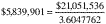
(iii) Because no amounts of rent are payable before the lease term, Step 2 in calculating the constant rental amount is to determine the present value as of the first day of the lease term of $1 to be received at the end of each rental period during the lease term. This results in a present value of $3.6047762. In Step 3 the amount determined in Step 1 is divided by the number of dollars determined in Step 2. Thus, the constant rental amount is $5,839,901 for each calendar year during the lease term computed as follows:
[T.D. 8820, 64 FR 26860, May 18, 1999, as amended by T.D. 8917, 66 FR 1040, Jan. 5, 2001]
Terms defined here
Where the text says “the term … means”. Select a term to jump to its definition.
Cross-references
Computed from the citations in the text of 26 CFR.
Code sections it cites
- § 467 Certain payments for the use of property or services
- § 168 Accelerated cost recovery system
- § 11 Tax imposed
- § 55 Alternative minimum tax imposed
Regulations it cites
- § 1.467-1 Treatment of lessors and lessees generally.
- § 1.856-3 Definitions.
- § 1.1275-5 Variable rate debt instruments.
- § 1.467-2 Rent accrual for section 467 rental agreements without adequate interest.
- § 1.446-3 Notional principal contracts.
Cited by 7 other regulations
- § 1.467-0 Table of contents.
- § 1.467-1 Treatment of lessors and lessees generally.
- § 1.467-2 Rent accrual for section 467 rental agreements without adequate interest.
- § 1.467-4 Section 467 loan.
- § 1.467-5 Section 467 rental agreements with variable interest.
- § 1.467-7 Section 467 recapture and other rules relating to dispositions and modifications.
- § 1.467-8 Automatic consent to change to constant rental accrual for certain rental agreements.
Amendment history
From the source citation at the end of the section, newest first. T.D. is a Treasury decision; FR is the Federal Register.
- Amended by T.D. 8917 (66 FR 1040)
- Issued by T.D. 8820 (64 FR 26860)
Where it sits in 26 CFR
- Subchapter A Income tax
- Part 1 Income taxes
- Taxable year for which deductions taken
Nearby sections
- § 1.466-4 Manner of and time for making election under section 373(c) of the Revenue Act of 1978.
- § 1.467-0 Table of contents.
- § 1.467-1 Treatment of lessors and lessees generally.
- § 1.467-2 Rent accrual for section 467 rental agreements without adequate interest.
- § 1.467-3 Disqualified leasebacks and long-term agreements.
- § 1.467-4 Section 467 loan.
- § 1.467-5 Section 467 rental agreements with variable interest.
- § 1.467-7 Section 467 recapture and other rules relating to dispositions and modifications.
- § 1.467-8 Automatic consent to change to constant rental accrual for certain rental agreements.