
Treasury Regulations · 26 CFR
§ 1.911-3. Determination of amount of foreign earned income to be excluded.
Regulation text, no changes From the eCFR, current as of October 15, 2026. The eCFR is an authoritative but unofficial editorial compilation of the Code of Federal Regulations; the official text is the annual CFR on govinfo. Compare it with this section on ecfr.gov (external site) or the official annual CFR on govinfo (external site).
Regulation under 26 U.S.C. § 911
Cite as 26 CFR § 1.911-3
At a glance
Read from the text and its source citation. Not part of the regulation.
- Status
- In the current eCFR
- Issued
- January 23, 1985 by T.D. 8006
- Issued under
- 26 U.S.C. § 911
- Length
- 5,262 words · about 23 min to read
- Defines
- 4 terms
- Cross-references
- cites 7 Code sections and 5 regulations; cited by 5
A, an employee of M Corporation during all of 1983 and 1984, worked in the United States from January 1 through April 30, 1983, and received $12,000 of salary for that period. A worked in country F from May 1, 1983 through the end of 1984, and is a qualified individual under § 1.911-2(a) for that period. For the period from May 1 through December 31, 1983, A received $32,000 of salary. M pays a bonus on December 20, 1983 to each of M's employees in an amount equal to 10 percent of the employee's regular wages or salary for the 1983 calendar year. The amount of A's bonus is $4,400 for 1983. The portion of A's bonus that is attributable to services performed in country F and is foreign earned income for 1983 is $3,200, or $32,000 × 10 percent. The remaining $1,200 of A's bonus is attributable to services performed in the United States, and is not foreign earned income.
The facts are the same as in example 1, except that M determines bonuses separately for each country based on the productivity of the employees in that country. M pays a bonus to employees in country F, in the amount of 15 percent of each employee's wages or salary earned in country F. A's country F bonus is $4,800 for 1983 ($32,000 × 15 percent), and is foreign earned income for 1983. If A also receives a bonus (or if A's bonus is increased) for working in the United States during 1983, that amount is not foreign earned income.
X corporation offers its employees a bonus of $40,000 if the employee accepts employment in a foreign country and remains in a foreign country for a period of at least four years. A, an employee of X, is a calendar year and cash basis taxpayer. A accepts employment with X in foreign country F. A begins work in F on July 1, 1983 and continues to work in F for X until June 30, 1987. In 1987 X pays A a $40,000 bonus. The bonus is attributable to services A performed from July 1, 1983 through June 30, 1987. The amount of the bonus attributable to 1987 is $5,000 (($40,000 ÷ 48) × 6). The amount of the bonus attributable to 1986 is $10,000 (($40,000 ÷ 48) × 12). A may exclude the $10,000 attributable to 1986 only to the extent that amount could have been excluded under section 911(a)(1) had A received it in 1986. The remaining $25,000 is attributable to services performed in taxable years before 1986. Such amounts may not be excluded under section 911 because they are received after the close of the taxable year following the taxable year in which the services giving rise to the income were performed.

The remaining portion of the reimbursement shall be treated as attributable to services performed in the year succeeding or preceding the year of the move. Amounts treated as attributable to services performed in a year succeeding or preceding the year of the move shall be excludable in the year of receipt only to the extent such amounts could be excluded under paragraph (d)(2) of this section in such succeeding or preceding year.

and subtracting the product from the total reimbursement. Amounts treated as attributable to services performed in a year succeeding or preceding the year of the move shall be excludable in the year of receipt only to the extent such amounts could be excluded under paragraph (d)(2) of this section in such succeeding or preceding year.
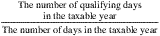
A is a U.S. citizen and calendar year taxpayer. A's tax home was in foreign country F and A was physically present in F for 330 days during the period from July 4, 1982 through July 3, 1983. The number of A's qualifying days in 1982 as determined under paragraph (d)(2) of this section is 181. In 1982 A receives $40,000 attributable to services performed in foreign country F in 1982. Under paragraph (d)(2) of this section A's section 911(a)(1) limitation is $37,192, that is the lesser of $40,000 (foreign earned income) or

The facts are the same as in example 1 except that in 1982 A receives $30,000 attributable to services performed in foreign country F. A excludes this amount from gross income under paragraph (d) of this section. In addition, in 1983 A receives $10,000 attributable to services performed in F in 1982 and $35,000 attributable to services performed in F in 1983. On his return for 1983, A must report $45,000 of income. A's section 911(a)(1) limitation for 1983 is the lesser of $35,000 (foreign earned income) or $49,329, the annual rate for the taxable year multiplied by a fraction the numerator of which is A's qualifying days in the taxable year and the denominator of which is the number of days in the taxable year ($80,000 × 184/365). On his tax return for 1983 A may exclude $35,000 attributable to services performed in 1983. A may only exclude $7,192 of the $10,000 received in 1983 attributable to services performed in 1982 because such amount is only excludable in 1983 to the extent such amount could have been excluded in 1982 subject to the section 911(a)(1) limitation for 1982 which is $37,192 ($75,000 × 181/365). No portion of amounts attributable to services performed in 1982 may be used in calculating A's section 911(a)(1) limitation for 1983. Thus, even though A could have excluded an additional $5,329 in 1983 if A had had more foreign earned income attributable to 1983, A may not exclude the $2,808 of remaining foreign earned income attributable to 1982.
C is a U.S. citizen and calendar year taxpayer. C establishes a bona fide residence and a tax home in foreign country J on March 1, 1982, and maintains a tax home and a residence in J until December 31, 1986. In March of 1982 C's employer, Y corporation, transfers stock in Y to C. The stock is subject to forfeiture if C returns to the U.S. before January 1, 1985. C elects under section 83(b) to include $15,000, the amount determined with respect to such stock under section 83(b)(1), in gross income in 1982. C's other foreign earned income in 1982 is $58,000. C elects under paragraph (e)(4)(iii)(B) of this section to treat the stock as if earned over the period of the substantial risk of forfeiture. The number of months in the period of the substantial risk of forfeiture is thirty-four. The number of months in the taxable year 1982 within the period of foreign employment is ten. For purposes of determining C's section 911(a)(1) limitation, $4,412 (($15,000/34) × 10) of the amount included in gross income under section 83(b) is treated as attributable to services performed in 1982, $5,294 is treated as attributable to services to be performed in 1983, and $5,294 is treated as attributable to services to be performed in 1984. In 1982, C excludes $62,412 under section 911(a)(1). That is the lesser of foreign earned income for 1982 ($58,000 + $4,412) or the annual rate for the taxable year multiplied by a fraction the numerator of which is C's qualifying days in the taxable year and the denominator of which is the number of days in the taxable year ($75,000 × 306/365). C continues to perform services in foreign country J throughout 1983 and 1984. C would be able to exclude the remaining $5,294 attributable to services performed in 1983 and $5,294 attributable to services performed in 1984 if those amounts would be excludable if they had been received in 1983 or 1984 respectively. If C is entitled to exclude the additional amounts, C must claim the exclusion by filing an amended return for 1982.
D is a U.S. citizen and a calendar year taxpayer. In September, 1984 D moves to a foreign country K. D is physically present in K, and D's tax home is in K, from September 15, 1984 through December 31, 1985. D receives $6,000 in April, 1985 from his employer, as a reimbursement for expenses of moving to K, pursuant to a written agreement that such moving expenses would be reimbursed to D upon successful completion of 6 months employment in K. Under paragraph (e)(15)(i) of this section, the reimbursement is attributable to services performed in K. Under the physical presence test of § 1.911-2(a)(2)(ii), among other periods D is a qualified individual for the period of August 10, 1984 through August 9, 1985, which includes 144 days in 1984. Under paragraph (e)(5)(ii)(A) of this section, for the purpose of determining the amount eligible for exclusion, the reimbursement is considered attributable to services performed in 1984 (the year of the move) because D is a qualified individual under § 1.911-2(a) for a period that includes 120 days in 1984. The reimbursement may be excluded under paragraphs (d)(2) and (e)(2) of this section, to the extent that D's foreign earned income for 1984 that was earned and received in 1984 was less than the annual rate for the taxable year multiplied by the number of D's qualifying days in the taxable year over the number of days in D's taxable year ($80,000 × 144/366), or $31,475.
The facts are the same as in example 4 except that D is not a qualified individual under the physical presence test, but is a qualified individual under the bona fide residence test for the period of September 15, 1984 through December 31, 1985. Under paragraph (e)(5)(ii)(A) of this section, for the purpose of determining the amount eligible for exclusion, the reimbursement is considered attributable to services performed in 1984 and 1985 because D is not a qualified individual for a period that includes 120 days in 1984 (the year of the move). The portion of the reimbursement treated as attributable to services performed in 1984 is $6,000 × 108/366, or $1,770, and may be excluded, subject to D's 1984 section 911(a)(1) limitation. The balance of the reimbursement, $4,230, is treated as attributable to services performed in 1985, and may be excluded to the extent provided in paragraphs (d)(2) and (e)(2) of this section.
The facts are the same as in example 4, with the following additions. Before D moved to K, D and his employer signed a written agreement that D would perform services for the employer for at least one year, primarily in country K, and, if D did not voluntarily cease to work for the employer primarily in country K before one year had elapsed, the employer would reimburse D for one half of D's expenses, up to a maximum of $4,000, of moving back to the United States. The agreement also stated that, if D did not voluntarily leave the employment in K before two years had elapsed, the employer would reimburse D for all of D's reasonable expenses of moving back to the United States. The agreement further stated that D's right to reimbursement would not be conditioned upon the performance of services after D ceased to work in K. D worked in country K for all of 1985. On January 1, 1986, D left K and moved to the United States. In February, 1986 the employer paid D $3,500 as reimbursement for one-half of D's expenses of moving to the United States. Although D did not fulfill the condition in the agreement to receive full reimbursement, all of the conditions in the agreement set forth definitely ascertainable standards and no condition could be fulfilled after D moved back to the United States. The agreement fulfills the requirements of paragraph (e)(5)(i) of this section, and therefore is evidence that the reimbursement should not be attributable to future services to be performed at D's new principal place of work. Under the facts and circumstances, the reimbursement is attributable to services performed in K. Under paragraph (e)(5)(ii)(A) of this section, the entire reimbursement is attributable to services performed in 1985. The amount attributable to 1985 may be excluded to the extent provided in paragraphs (d)(2) and (e)(2) of this section.
(Sec. 911 (95 Stat. 194; 26 U.S.C. 911) and sec. 7805 (68A Stat. 917; 26 U.S.C. 7805) of the Internal Revenue Code of 1954)
[T.D. 8006, 50 FR 2966, Jan. 23, 1985]
Terms defined here
Where the text says “the term … means”. Select a term to jump to its definition.
Cross-references
Computed from the citations in the text of 26 CFR.
Code sections it cites
- § 911 Citizens or residents of the United States living abroad
- § 119 Meals or lodging furnished for the convenience of the employer
- § 402 Taxability of beneficiary of employees’ trust
- § 403 Taxation of employee annuities
- § 6511 Limitations on credit or refund
- § 83 Property transferred in connection with performance of services
- § 7805 Rules and regulations
Regulations it cites
- § 1.911-2 Qualified individuals.
- § 1.911-6 Disallowance of deductions, exclusions, and credits.
- § 1.72-8 Effect of certain employer contributions with respect to premiums or other consideration paid or contributed by an employee.
- § 1.83-3 Meaning and use of certain terms.
- § 1.83-2 Election to include in gross income in year of transfer.
Cited by 5 other regulations
Amendment history
From the source citation at the end of the section, newest first. T.D. is a Treasury decision; FR is the Federal Register.
- Issued by T.D. 8006 (50 FR 2966)
Where it sits in 26 CFR
- Subchapter A Income tax
- Part 1 Income taxes
- Earned Income of Citizens or Residents of United States
Nearby sections
- § 1.909-5 2011 and 2012 splitter arrangements.
- § 1.909-6 Pre-2011 foreign tax credit splitting events.
- § 1.911-1 Partial exclusion for earned income from sources within a foreign country and foreign housing costs.
- § 1.911-2 Qualified individuals.
- § 1.911-3 Determination of amount of foreign earned income to be excluded.
- § 1.911-4 Determination of housing cost amount eligible for exclusion or deduction.
- § 1.911-5 Special rules for married couples.
- § 1.911-6 Disallowance of deductions, exclusions, and credits.
- § 1.911-7 Procedural rules.